
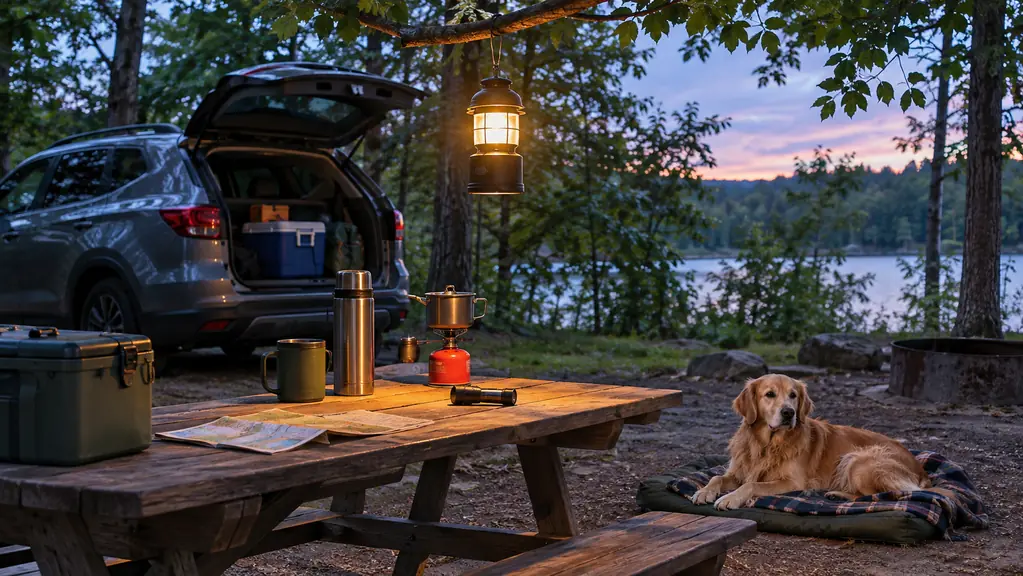
Dark comes early in the Tennessee hills once September rolls around, and it comes fast. I have pulled into a campsite at Fort Loudoun more than once with twenty minutes of gray light left, a dog who needed a walk, and a supper that still had to be cooked. A headlamp does not solve that. It lights a circle three feet in front of my face and leaves the rest of the world black, and every time I turn my head to look for the salt, the whole camp swings around with me. By the time I get the stove lit I have knocked over a water jug and lost the matches twice.
What fixed it for me was a rechargeable lantern and about ten minutes of thinking ahead. The one in my gear bin is the Lepro 1000LM LED Camping Lantern, and it has been riding around in the back of my Forester for a couple of seasons now. It is not a fancy piece of equipment. It hangs from a hook, it throws light in every direction at once, and it does not leave me holding anything, which matters when both hands are busy with a stove or a leash. What follows is the order I actually do things in, starting about half an hour before sunset.
One lantern on a branch beats a headlamp in your teeth
The Lepro 1000LM puts out 1000 lumens across a 360 degree beam, hangs from a hook on top or a hook at the base, and recharges at 5 volts so you are not feeding it batteries every trip.
Amazon Check Today's Price on Amazon →Step 1: Get the Light Up Before the Gear Comes Out
The mistake I made for years was waiting until it was fully dark to think about light. By then I am holding a flashlight in my teeth, the stove is hissing, and Biscuit is orbiting my knees because he can tell I am not paying attention to him. Now the lantern comes out of the bin before the cooler does. I hang it, switch it on, and unload into a camp that is already lit instead of one I keep bumping into.
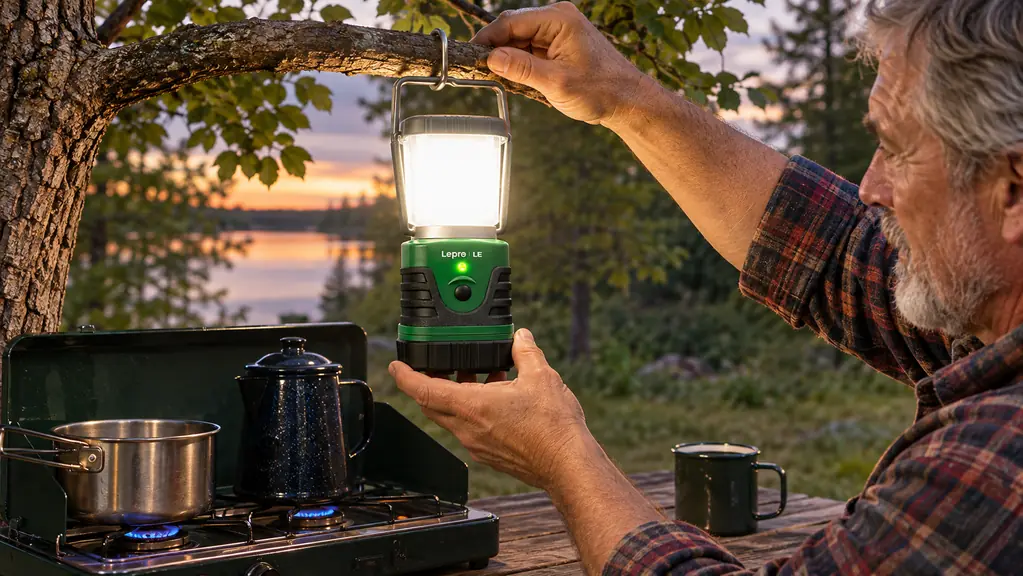
The hook on top of the lantern is what makes this easy. There is a second hook at the base, which I will get to in a minute, but the top hook is the one I use most trips. It goes over the strut of the open hatch on the Forester while I am still digging gear out, then it moves to a branch or the shelter frame once the table is clear. No tools, no tying, no wet knot to pick apart in the morning.
Getting light up early also means I can see what I am doing when I level the stove and when I check where the dog's tie-out is staked. Those are two jobs I do not want to be guessing at in the dark. Ten minutes of light while there is still some sky left buys me a calm evening later, and it means I am not the person at the campground swinging a beam through somebody else's site at nine o'clock. Two Octobers ago at a forest service site outside Bryson City I did it the old way one last time: headlamp on my forehead, cooler lid propped open, and the tie-out stake somewhere in the leaves I could not see. It took me twenty minutes to find that stake the next morning. Now the stake goes in while the lantern is already hanging, and I can see the ground I am working on.
Step 2: Hang It High, Out Past the Edge of the Table
A lantern wants to be above your head and out past the edge of the table, not sitting on the tabletop in front of you. Set it down at eye level and you will spend the whole evening looking into the source, which is how you end up with a headache and no night vision. The Lepro throws its beam across 360 degrees, so it does not care which way it faces. Hanging it high turns one hot spot into a room.
In practice I hang mine about a foot above my standing height, off a branch if the site has one or off the shelter frame if it does not. The open hatch of the Forester is another good spot, and it lights the tailgate area where the cooking bin lives. The lantern weighs just over a pound, so a branch that would not hold a string of lights will hold this one without sagging. I carry a short loop of paracord in the bin in case the only branch within reach is higher than I want, and I have used it maybe three times in two seasons. What I check before I walk away is that the lantern is above my eyeline, not level with it. If I can look straight into it while standing at the stove, it comes down and goes out further.
At 1000 lumens it will cover a picnic table, two camp chairs, the stove, and the ground out past the edge of the site. That is more than I need for sitting and about right for cooking and cleaning up. It also means I stopped carrying three different lights to cover one campsite, which is the sort of thing that happens when you have been at this a while and have a tote bag full of half solutions.
Step 3: Match the Mode to the Job
The lantern has four light modes. I will be honest with you, most nights I use two of them. The brightest setting goes on for cooking, for cleanup, and for finding whatever rolled under the car. The lower setting goes on once the dishes are done and I am sitting down with a cup of coffee and a dog leaning on my boot.
The reason the modes matter is that a single-brightness light is either too much or not enough. Too bright and you lose your night vision, you cannot see the stars, and every moth in the county comes to visit. Too dim and you cannot tell whether the chicken is done. Four settings means I get a working light and a sitting light out of the same piece of gear, and I am not packing both.
When I want more light on a specific job, I move the lantern rather than turn it up. If I am doing dishes, it comes off the branch and hangs closer to the wash tub. If I am sitting, it goes back up and out of the way. Position does more work than the modes do, and it takes about two seconds. The first trip I used it, I left it on the brightest setting the whole evening because I did not trust the lower ones. By nine o'clock I had a headache, the moths had arrived in numbers, and I could not see a single star through the trees. The next night I turned it down after the dishes and the camp felt twice as big. That is not a thing the spec sheet tells you.
Step 4: Protect the Battery and Recharge on a Schedule
The battery in this lantern is 4400mAh, and the rated runtime is 12 hours, depending on how bright you run it. I run mine bright for maybe an hour a night and lower than that the rest of the time, so a two or three night trip does not come close to draining it. What drains it is sitting in a cold garage half empty for three weeks between trips. My bad habit was leaving it in the bin from the last trip of the fall until the first trip of the spring. That is five months in an unheated garage in Chattanooga, and it came back to me sluggish on the first night out. Now it goes on the charger the same night I unpack the cooler, whether I think it needs it or not, and I have not had a slow start since.
I top it off the night before I leave, same as I do my phone, and I plug it in again the night I get home while the dirty pots are still in the sink. It runs at 5 volts, so it charges off the same small wall adapter I use for everything else. That adapter lives in the glovebox, which means it does not get left on the kitchen counter on the morning I am already running late.
The one caution I would pass along is that water resistant is not the same as waterproof. Mine has been through plenty of damp mountain mornings without a problem, but I do not leave it standing in a puddle or hanging out in a downpour. Hanging it, which is what the hooks are for anyway, keeps it off the wet ground and out of the splash zone around the wash basin.
Step 5: Run Two Lights and Put One Low for the Dog
Here is the part that matters most to me. One light hung high lights the camp, but it leaves the ground under the table dark and it leaves the edge of the site dark. Biscuit does not care for the dark edge of the site. He is six years old, about 45 pounds, and once the sun drops he wants to be somewhere he can see me, which usually means he is standing on my foot while I try to eat.
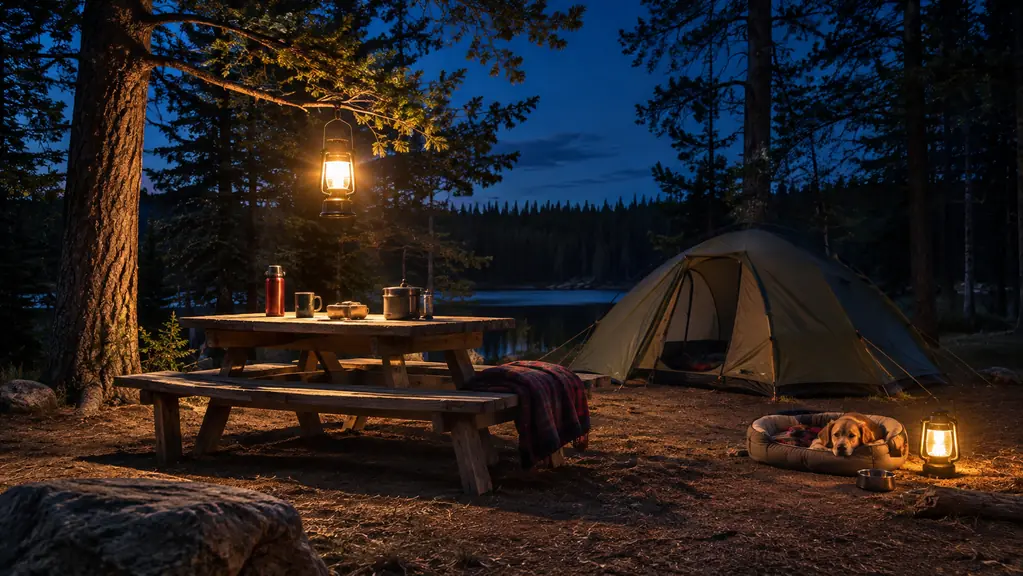
So I run a second light low. This is where the hook on the base earns its keep. I hang it from the leg of the picnic table, or set it on the ground under the table, and it throws light out flat across the ground instead of down into my eyes. The dog gets a lit patch to lie on and I get a dog who settles instead of pacing the perimeter of the site.
His bed goes just outside the brightest ring, close enough that he can see me and far enough that he is not staring into the light. That one change has done more for my sleep on camping trips than any jacket or pad I have bought him, and it took one extra lantern and about thirty seconds of setup. If you camp with a dog that gets restless after dark, start here before you buy another piece of gear.
What Else Helps
A headlamp still belongs in your pocket. When I am doing something with both hands, hitching the dog or working a stubborn stove valve, the headlamp is what I reach for. It is not a replacement for the lantern. It is a spotlight for close work, and the lantern is the room. Together they cover everything I have ever needed light for at a campsite.
Two small additions that have paid off: a reflective leash so I can find Biscuit when he wanders to the end of his tie-out after dark, and a cheap solar path light staked by the tent door so I can find the zipper at two in the morning without turning on anything bright enough to wake me up properly. Neither one is expensive and neither one takes up real space in the vehicle.
The last thing I would say is to give the lantern a dedicated home in the vehicle. Mine lives in the top bin by the hatch, in the same place every trip, so I am never the person unpacking three tote bags in the dark looking for a light. That sounds like a small thing. It is the difference between setting up calm and setting up annoyed, and after a three hour drive that difference is most of the trip.
Twelve hours of rated runtime and a 360 degree beam mean one lantern hung over the table lights the whole camp, and the hook at the base gives the dog a lit patch of his own.
Hang one high, set one low, get your evenings back
The Lepro 1000LM runs 1000 lumens through a 360 degree beam, hangs from a hook on top or a hook at the base, and recharges at 5 volts. Charge it before you leave and it covers a weekend of evenings.
Amazon Check Today's Price on Amazon →