
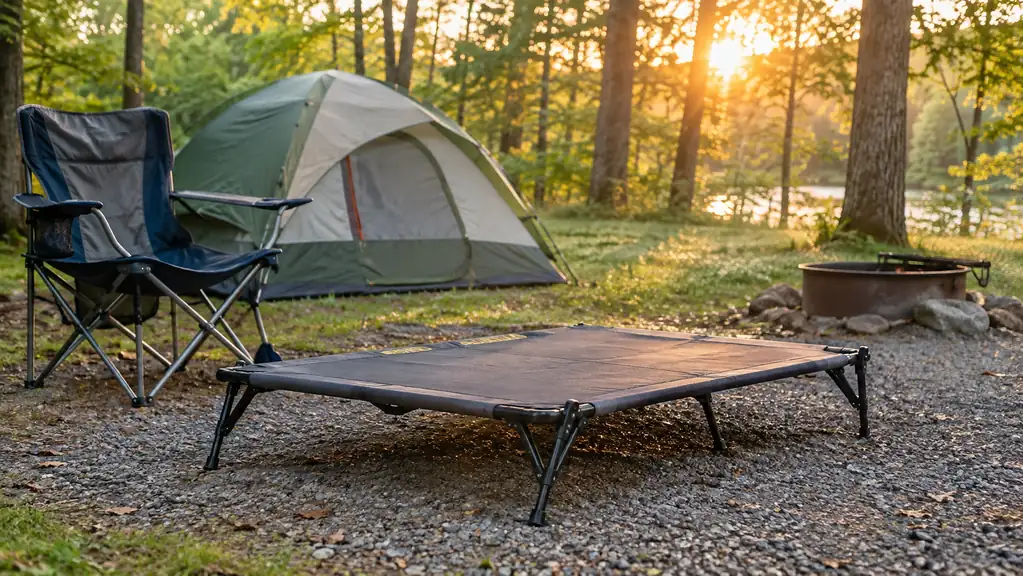
Biscuit does not sleep on the ground. She will lie down on it, sure, and she will roll in it, but the minute the sun drops behind the ridge at Tims Ford she wants air under her belly and she wants it now. For two seasons I solved that with a folded moving blanket, then a closed-cell foam pad that soaked through by the second night and smelled like lake bottom for a month. The Veehoo elevated dog cot is the first thing I have put under her that came up dry after three nights of rain, and that is the short version of why it rides in the back of the Forester all season.
I am not a gear reviewer. I am 58, I spent 31 years turning wrenches on school buses, and I now camp out of a 2017 Subaru Forester most weekends from April through the end of October. Tennessee state parks, a few national forest campgrounds over in western North Carolina, two or three nights at a time, usually just me and the dog. I bought the Veehoo because the review count was thick and the design was simple enough to trust. Then I used it for a full season, about fourteen trips, and I have things to say about it.
The Quick Verdict
A raised, breathable cot that keeps a 45 pound dog off wet ground and rinses clean in thirty seconds. Not insulated, not soft, and not for chewers, but it earned a permanent spot in my camp setup.
Amazon Check Today's Price →The bed that came up dry after three nights of rain
Veehoo's 42 x 30 elevated cot. 6.61 pounds, no tools to set up, non-skid bottom that has not slid on gravel, dirt, or a tent platform. It has been in my Forester since April.
Amazon Check Today's Price on Amazon →How I've Used It
The cot goes up on the first afternoon and stays up until we leave. I set it beside my camp chair, close enough that Biscuit can rest a paw against my boot if she wants to, and that is where she spends the evening while I read or fight with the fire. When it is finally time to turn in, she walks to it on her own. That never happened with a pad. A pad got pawed at, circled, and abandoned by midnight.
Fourteen trips is enough to see a pattern. On the warm ones, the mesh is the reason she settles instead of panting and shifting every twenty minutes. On the cold ones I fold a fleece throw over the mesh and she gets a raised, softer spot instead of a cold one, and I get to sleep through the night instead of listening for her. Either way she is off the ground, and off the ground is the whole argument.
I have set it up on gravel, on packed dirt, on grass at a campground outside Townsend, and once on the wooden platform of a state park tent pad. It has not wobbled on any of them. The non-skid bottom is the reason, and I found that out the hard way the one night I set it on a slight slope next to the cooler and fully expected it to slide downhill. It did not move.
The trip I keep coming back to was the second weekend of October at Rock Island, when the temperature dropped to 38 by midnight and I had not worked out the blanket trick yet. Biscuit shifted and huffed for two hours before I gave up, dug the fleece out of my duffel, and laid it over the mesh. She was asleep in four minutes. That was the night I stopped thinking of the cot as summer-only gear.
Ray came along on four of those trips and his verdict was shorter than mine. He said it looked like a cot somebody cut down for a kid, then he watched Biscuit sleep through a thunderstorm on it and stopped saying that. He now carries it to the tent pad without being asked, which from him is a five star review.
What 42 by 30 by 7 Actually Gets You
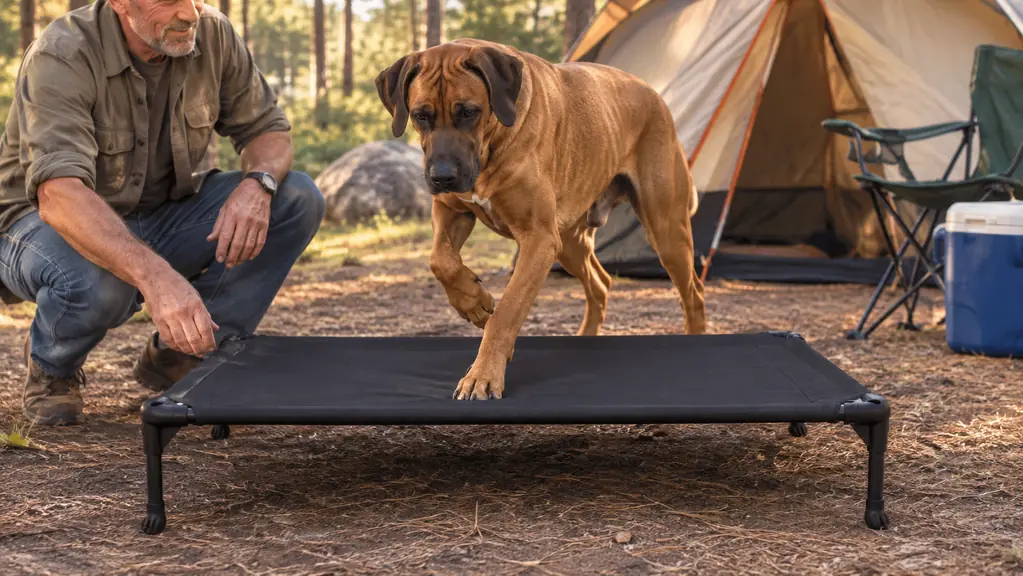
The listing reads 42 inches long, 30 inches wide, and 7 inches off the ground, with a frame weight of 6.61 pounds. Biscuit is 45 pounds and she can stretch out flat with a couple of inches to spare at the tail. A 70 pound dog would fill it edge to edge. Two dogs would not fit and I would not try, no matter how well they get along at home.
Seven inches sounds like nothing until you have slept on ground that holds water. Seven inches is enough to get a dog above the groundwater that seeps into a tent pad overnight, and enough that air moves under the mesh instead of being blocked by dirt. The morning after a storm at Cumberland Mountain, the ground under the cot was dark and wet and the mesh on top was dry. That is the whole test and it passed it.
The height is also why it works inside the tent. Mine is not a tall tent and the cot slides in without me having to duck around it or step over it in the dark. It also puts Biscuit up where she can see out over camp from a lying position, which for an Australian Shepherd mix is apparently a spiritual need. She watches the whole loop from up there and does not fuss.
I paced it out against my camp chair the first afternoon because I wanted to know whether it would crowd the sitting area. Laid out, it takes roughly the footprint of a folding chair with a hand's width to spare, so it fits in the triangle between the chair, the cooler, and the tent door without anyone stepping over anyone. On the tent pad it sat along the long wall and I still had room to walk in and out in the dark.
The Mesh Does the Real Work
Textilene is the same woven, coated fabric patio chairs are made of. It does not hold water, it does not hold hair the way fleece does, and it does not pack down and stay flat the way foam does after a season of a 45 pound dog flopping onto it. The listing names cooling, easy to clean, and elevated as the features, and in my experience all three of those are honest.
Cleaning is a hose and thirty seconds. Hair rinses off instead of weaving itself into a seam. Mud from a wet morning walk comes off with a rag and a splash from the water jug. After a full season it looks close to how it looked in April, which is more than I can say for the pad that came before it.
The cooling part deserves a plain explanation, because it is easy to oversell. The mesh does not refrigerate anything. What it does is let air pass under the dog instead of trapping body heat in foam. On an 85 degree afternoon in July, that is the difference between a dog that lies down and a dog that paces, digs at the ground, and generally makes a nuisance of herself while you are trying to start dinner.
The first genuinely hot trip was Memorial Day weekend at Edgar Evins, and I watched her get up off the cot, walk six steps, and lie down in the shade of the car. Then she got up and went back to the cot. She did that twice before she settled. She was choosing the mesh over the dirt and over the shade, and that told me more than any product listing could.
Six weeks in, the mesh still looked new. The foam pad it replaced had already gone flat and sour.
Setup, Takedown, and Living With 6.61 Pounds
No tools. That is straight from the listing and it is true. The frame is a set of metal tubes that slot together, the mesh sleeve slides over the top, and it is standing in about two minutes once you have done it twice. The first attempt took me longer because I put the short legs on the long side. You will do that exactly once.
Packing it is the part I did not expect to like. It breaks down flat enough to slide behind the driver's seat in the Forester, and I stopped noticing it was there by the third trip. What I do notice is the difference between carrying a soggy pad to the car and carrying a dry cot, which is no comparison at all when it is 7 a.m. and you have not had coffee.
The heavy duty frame claim is the part I was skeptical of, because that phrase is printed on everything and means nothing. What convinced me was a weekend when Biscuit launched off the cot after a squirrel and the cot did not tip, flip, or chase her. It shifted maybe an inch. At the end of the season the frame is still square, with no bends at the joints and no rust where the finish has been banged around in the back of the car.
Where It Falls Short
Two things I do not love. First, the mesh is not soft. Biscuit took to it immediately, but she is not a fussy dog. My sister's older Lab planted her feet and refused it for a whole evening before she gave in. If your dog has only ever slept on thick bedding indoors, bring a thin blanket for the first trip and save yourself the standoff.
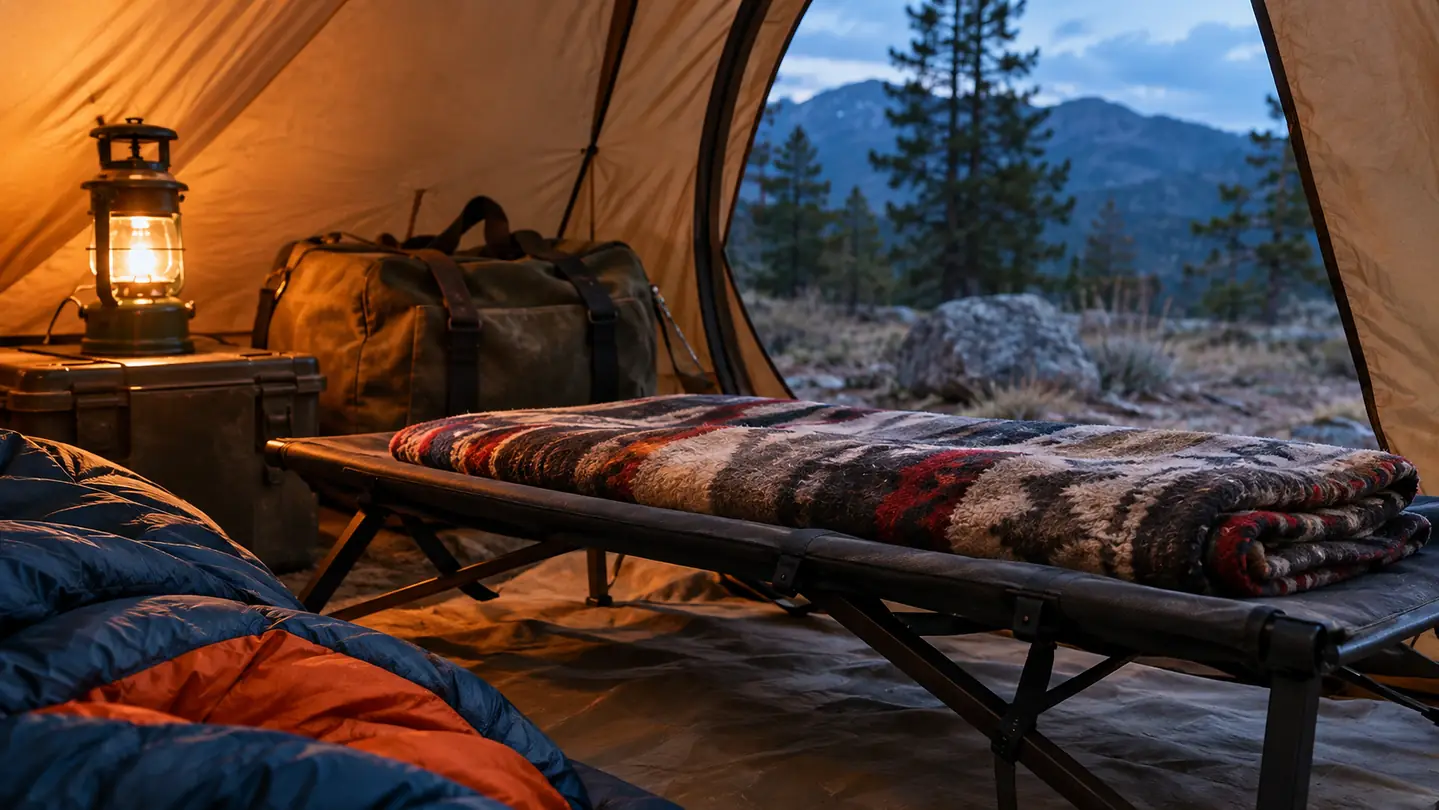
Second, there is no insulation anywhere in this design, and that matters once the overnight temperature drops below about 45 degrees. The cot gets a dog off cold ground, which helps, but air moving under a mesh panel pulls warmth out of a belly all night long. Biscuit runs warm and she still curls tight and shivers by two in the morning in late October. My fix is a fleece throw folded in half over the mesh, which also keeps her nails off the fabric.
The other thing I would tell a friend is that this is a bed, not a chew toy. The mesh is strong for what it is, but a determined puppy will find a corner. My dog is six and has never chewed a bed in her life, so it has not come up. I still would not leave a chewer alone with it in a tent.
One more note on weather. The frame has been through two hard rainstorms and a night of wind that flattened my tarp. It did not tip and it did not fold up under her. The mesh does hold water on top like a shallow bowl until you tip it out in the morning, which is worth knowing if rain is in the forecast and you would rather not find a wet cot at six in the morning.
What I Tried Before This
Before the cot I used a closed-cell foam pad, which is cheap, light, and fine until it rains. Once a pad takes on water it stays heavy and sour for the rest of the trip and there is no drying it out inside a tent. The cot has no padding to soak. That is the whole reason I switched and the reason I am not going back to a pad.
I also tried letting her sleep on a blanket in the footwell of the Forester on the one trip where it poured for two days. She hated it, I hated it, and the car smelled like wet dog for a week afterward. A raised cot under the awning is a better answer, and it keeps the car a car instead of a kennel.
What I Liked
- Stays dry through multi-night rain, which no pad I have owned has managed
- Textilene mesh rinses clean with a hose and does not hold hair
- Non-skid bottom has not slid on gravel, packed dirt, grass, or a wooden tent platform
- Sets up in about two minutes with no tools, and packs into the corner of a small SUV
- 42 x 30 surface gives a 45 pound dog room to stretch out flat
Where It Falls Short
- No insulation at all, so below about 45 degrees you need a blanket over the mesh
- The sleeping surface is firm and not soft, and picky dogs may need a night to accept it
- Not built for chewers, and the mesh corner is the weak point
- Not a backpacking weight at 6.61 pounds, so this is a vehicle camping item only
Who This Is For
You camp with a dog somewhere between 30 and 70 pounds, you camp out of a vehicle or close to one, and you are tired of a bed that comes home wet. You want something that goes up fast in the rain, that you can hose off in the driveway, and that gets your dog off ground that holds water. If your dog runs hot, or if you are the kind of person who worries about a dog lying on cold dirt all night, this solves that specific worry for a reasonable amount of money.
Who Should Skip It
Skip it if you backpack, because you will resent every one of those 6.61 pounds. Skip it if you have a giant breed over 80 pounds, because 42 by 30 is not going to give that dog room to sprawl. Skip it if your dog is a chewer, or if you camp in real cold, where you would be better off with an insulated pad inside the tent. And skip it if your dog demands a soft bed, because this is a taut panel of fabric and nothing more, and no amount of praise from me will change what your dog thinks about that.
Fourteen trips later, it is still the first thing I set up
Veehoo elevated cot, 42 x 30 x 7, heavy duty frame, non-skid bottom, Textilene mesh that rinses clean. Add a fleece throw for October nights and you are set for the season.
Amazon Check Today's Price on Amazon →