
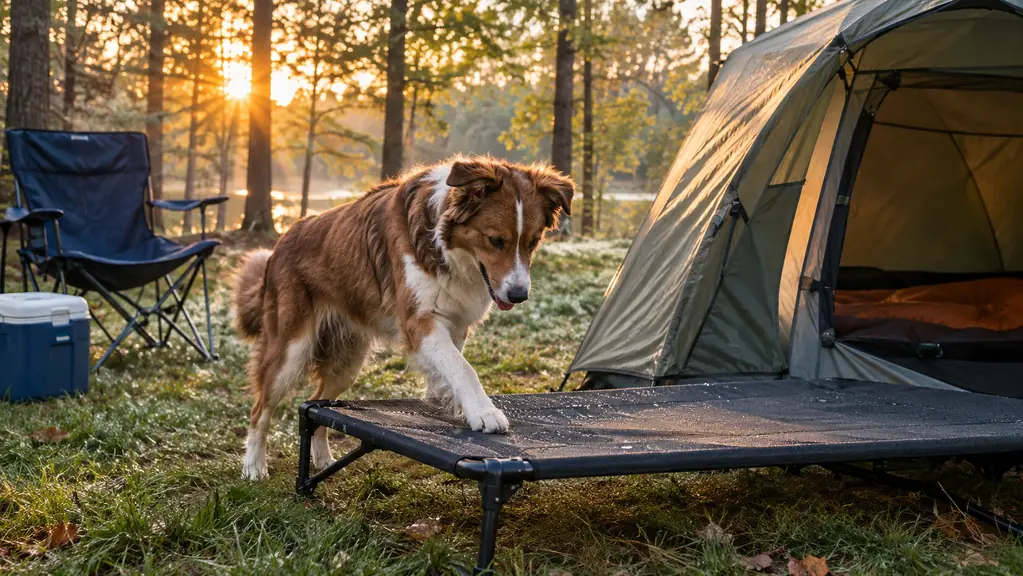
The short answer first, since you may be reading this with a tent half packed and a dog watching you. If your dog sleeps on the ground outside the tent, the Veehoo Outdoor Elevated Dog Bed is the one I load first. If your dog sleeps inside the tent with you, or curled on the cargo floor of the SUV, the Chuckit Travel Bed makes more sense. Same job, two different nights, and picking wrong costs you sleep.
I am Marla Quintrell. I am 58, retired after a career of turning wrenches on school buses, and I live in Chattanooga, Tennessee. Most weekends from April into late October, my husband Ray and I load a 2017 Subaru Forester and drive to a state park in Tennessee or over into western North Carolina for two or three nights. Biscuit comes along. He is a 6-year-old Australian Shepherd mix, right around 45 pounds, and he runs warm. He will sprawl on cool ground at four in the afternoon and then get restless and chilly by two in the morning when the temperature drops. That is the exact problem both of these beds are trying to solve, from opposite directions.
| Veehoo Elevated Dog Bed | Chuckit Travel Bed | |
|---|---|---|
| Off the ground | Lifts the dog 7 inches off dirt, gravel or wet grass | Lies directly on the ground with no clearance |
| Airflow | Textilene mesh lets air move under the dog | Fabric and fill hold air still |
| Warmth on cold nights | Mesh holds no heat at all | Fill and fabric keep body heat in |
| Packs down | Rigid frame, rides flat in the cargo area | Rolls into a bundle and straps shut |
| Setup | No tools needed, about a minute to open | Unroll it and it is ready |
| Cleaning | Hose off the mesh, dries fast in the sun | Cover comes off for the washing machine |
| Stability | Heavy duty frame and non-slip feet, does not tip when a dog steps on the edge | No frame, so nothing to tip and nothing holding a shape |
| Floor space in the tent | 42 by 30 inches of rigid frame takes real floor | Squishes into a corner |
| Chew resistance | Mesh is not chew proof | Fabric is not chew proof |
| Upfront cost | Costs more upfront | Costs less upfront |
| Best for | Sleeping on the ground outside the tent | Inside the tent, the back seat, or a motel room |
Where Veehoo Wins
The Veehoo bed's whole premise is clearance. It measures 42 inches long, 30 wide and 7 tall, with a Textilene mesh sleeping surface stretched in a metal frame. Seven inches does not sound like much until you have watched a dog try to sleep on ground that has been soaking up dew since sunset. Wet ground pulls heat out of a dog's chest and belly all night, and the dog that runs warm at noon is often the same dog shivering at three in the morning. Up off the ground, most of that heat transfer stops. On the first trip I used the Veehoo, Biscuit got on it before I had finished zipping the tent flap and stayed there until my alarm went off. That was a Friday in late May at a state park outside Dayton, Tennessee, on a site where the grass had not dried out since a storm two days before. I had tried a folded wool blanket first, laid flat on the tent pad, and by ten o'clock it was damp straight through and Biscuit had pushed it into a pile in the corner.
Mesh breathes in a way that fabric and foam cannot. Air moves under the dog instead of getting trapped, which matters on warm afternoons when you want him off the hot dirt but still in camp with you. I use mine as a daytime cot as much as a night bed. After a hike he gets on it in the shade and cools down faster than he does sprawled on grass, and the surface wipes clean when he tracks pine sap onto it. The sleeping surface runs the full 42 by 30 inches, so a 45-pound dog can stretch out flat with his legs out behind him instead of curling into a ball the way he does on a soft bed. Biscuit takes up most of the length and still has room to roll over without his feet hitting frame.
What I did not expect to appreciate is the frame. The listing calls it heavy duty, and what that means in practice is that a 45-pound dog stepping on the edge does not tip it or fold it. The feet are non-slip, so it stays where I set it on a tent pad instead of sliding toward the door overnight. Cleaning is a hose and ten minutes in the sun. There is no cover to unzip and no fill to dry out, which for a car camper who comes home with a muddy dog is the difference between packing it away and leaving it in the yard for two days.
Seven inches of mesh between a warm dog's belly and wet ground is the difference between a dog that settles at nine and one that is pacing at two.
Where Chuckit Wins
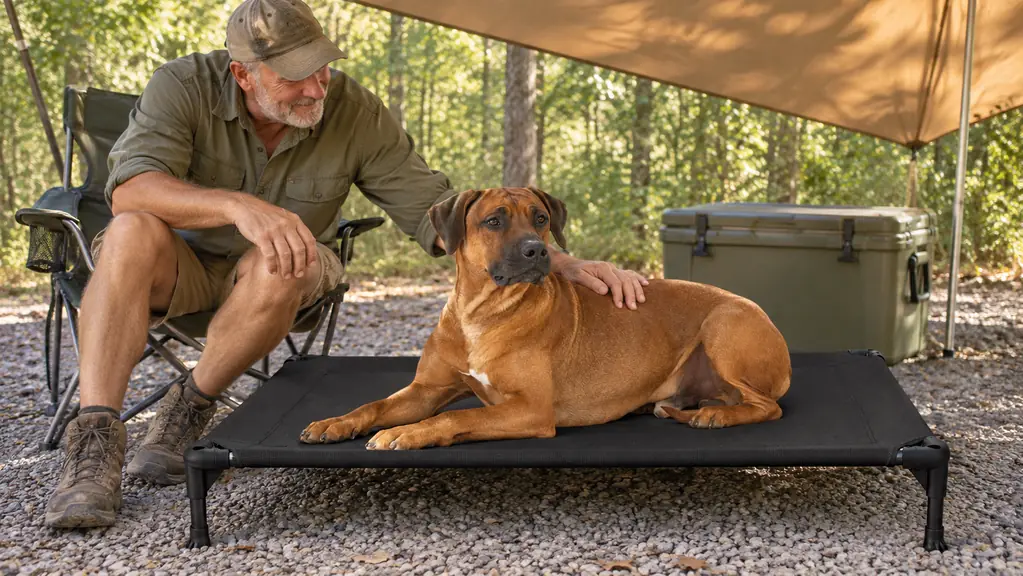
The Chuckit Travel Bed wins the packing argument outright. It is a soft bed that rolls up and holds itself with a strap, so it drops into the gap behind the Forester's rear seat or on top of a duffel without any negotiating. The Veehoo is 42 by 30 inches of rigid frame. It lies flat, and flat takes up real room. On a two-night trip with two people, a cooler and a dog crate, I plan around the cot. I do not plan around the Chuckit. For scale, the cargo area with the seats down is already carrying a cooler, a two-burner stove, a duffel with the tent and two sleeping bags, and a water jug. The cot eats a strip of that floor about the width of the cooler. The travel bed goes on top of the duffel and I forget it is there until I need it.
Cold is the other side of the coin. Mesh holds no heat, and on a night that drops into the low forties, a dog that was comfortable in July will curl tight and shiver. The Chuckit is fabric and fill. It traps warmth, and the shape gives a dog something to nest into rather than stretch out on. Inside a tent, where the walls cut the wind, that warmth is worth more than airflow. Biscuit sleeps warmer on it in October than he does on the cot, and he does not spend half the night thumping around looking for a better spot. One weekend in late September near Boone, the overnight low came in at 41 and there was frost on the picnic table at six. Biscuit had been sprawled on the cool dirt all afternoon and was up and shivering by the time the fire died. He was on the travel bed inside the tent by nine and stayed there until I unzipped the door at seven.
It machine washes, which I appreciate more than I expected after a wet weekend in the Smokies. Pull the cover, run it through, let it air out. The cot has no cover to wash, which is faster for mud, but nothing beats a real wash after a dog has been in river water and rolled in leaf litter. It also costs less upfront, and for a bed that sees two trips a year, that is worth weighing against the airflow.
The bed I load first when the dog sleeps on the ground
42 by 30 inches of Textilene mesh in a metal frame, no tools to set it up, and seven inches of clearance between your dog and whatever the ground did overnight. That is the Veehoo cot, and it goes in the Forester before the cooler does.
Amazon Check Today's Price on Amazon →Who Should Buy Which
Buy the Veehoo if your dog sleeps outside the tent, under a tarp or on a screened porch, and you camp where the ground stays damp. Buy it if your dog runs hot, if he is a sprawler, or if you want one bed that works as a daytime cot and a night bed after dark. It is also the better pick for a dog with stiff joints, simply because getting up off a firm surface is easier than pushing up out of a soft one.
Buy the Chuckit if your dog sleeps inside the tent with you, on the back seat, or in a motel room on the drive down. Buy it if space is tight, if you fly or hike in, or if your dog is a nester who wants to be wrapped up rather than stretched out. On a night below 45 degrees inside an unheated tent, the soft bed is the kinder choice for a thin-coated dog or an older one.
Some people land on both after a season or two. The cot for camp during the day and outside on warm nights, the travel bed inside the tent for the cold ones. I know folks who do it and swear by it. It is also two beds to pack, and if you are already tight on room in a small SUV, one of them will end up staying home on most trips.
What I'd Tell You Before You Pack
Set the bed up before the trip. Not at the campsite in the dark. Both of these are simple, but the mesh on the cot has to be seated properly before a dog puts weight on it, and the travel bed needs to be unrolled and aired so it is not a brick when you arrive. I do both in the driveway the day before and let Biscuit walk on them, so they smell like him before we leave. The cot takes about a minute to open, and the mesh needs to be pushed down over the frame rails evenly all the way around or you will get a sag in one corner. I learned that in the driveway and not at a campsite, which is the only reason it was a small annoyance instead of a bad night.
Put the bed where you actually want the dog, not where it happens to fit. My cot goes beside my chair under the tarp, which means the dog is close enough that I hear him if he gets up. That placement is half of why he settles at all. A bed shoved ten feet away at the edge of camp is a bed a dog will leave at midnight to come find you.
Size, Weight, and the Space in a Small SUV
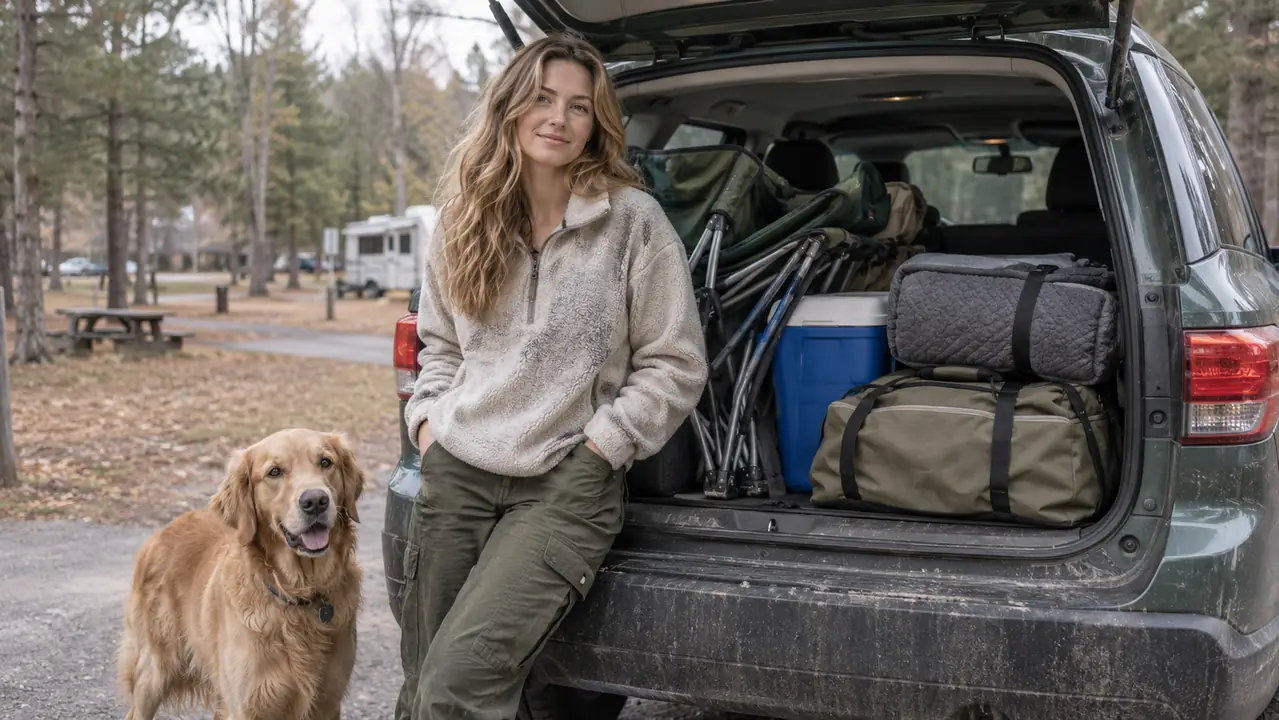
The cot measures 42 inches long, 30 wide and 7 thick and weighs about six and a half pounds. Lying flat in the back of a Forester with the seats down, it takes a strip of floor roughly the width of a cooler. Standing it on edge against the seat back works too, and that is usually what I do, but it needs something beside it so it does not slide. The mesh and frame are rigid. You cannot stuff it into a gap the way you stuff a duffel. I laid it out against the cargo wall once, mostly to settle an argument with Ray. Flat with the seats down, it still leaves a clear path along the driver's side for the cooler and the stove.
The Chuckit rolls and straps, so it goes wherever a jacket goes. On the drive home, when everything smells like woodsmoke and the dog is wet, that matters more than it sounds. I have driven home with the cot strapped on the roof and the travel bed inside the car, and I know which one I would rather unload in the rain.
The One Thing I'd Change About Each
The Veehoo does not fold. That is the honest limitation. It is light for its size and carries fine in one hand, but it will not disappear into a backpack. If you need a bed that packs down to the size of a sleeping bag, this is not that bed, and wanting it to be will not change the frame. I carried it a quarter mile to a picnic table on a day trip once, and it was fine in one hand, but that is about the outer limit. Anything past that and I would want a strap or a second trip.
The Chuckit does not get the dog off the ground, and on a wet weekend that shows. Morning dew, packed dirt after rain, a low spot where water pools under the tent floor, all of it comes up through a soft bed. If your dog is already stiff or has a tender shoulder, the ground underneath is still the ground. I learned that on a 38-degree night in October, on a trip where I left the cot at home to save room. Biscuit spent the night pressed against my sleeping bag instead, which was warm for him and not restful for either of us.
One bed, seven inches off the ground, and a dog that sleeps through
If your dog sleeps outside the tent, this is the setup that ended the two in the morning pacing for us. Textilene mesh, a frame that holds steady when a 45-pound dog steps on the edge, and no tools to set it up in the dark.
Amazon See the Veehoo Cot on Amazon →