
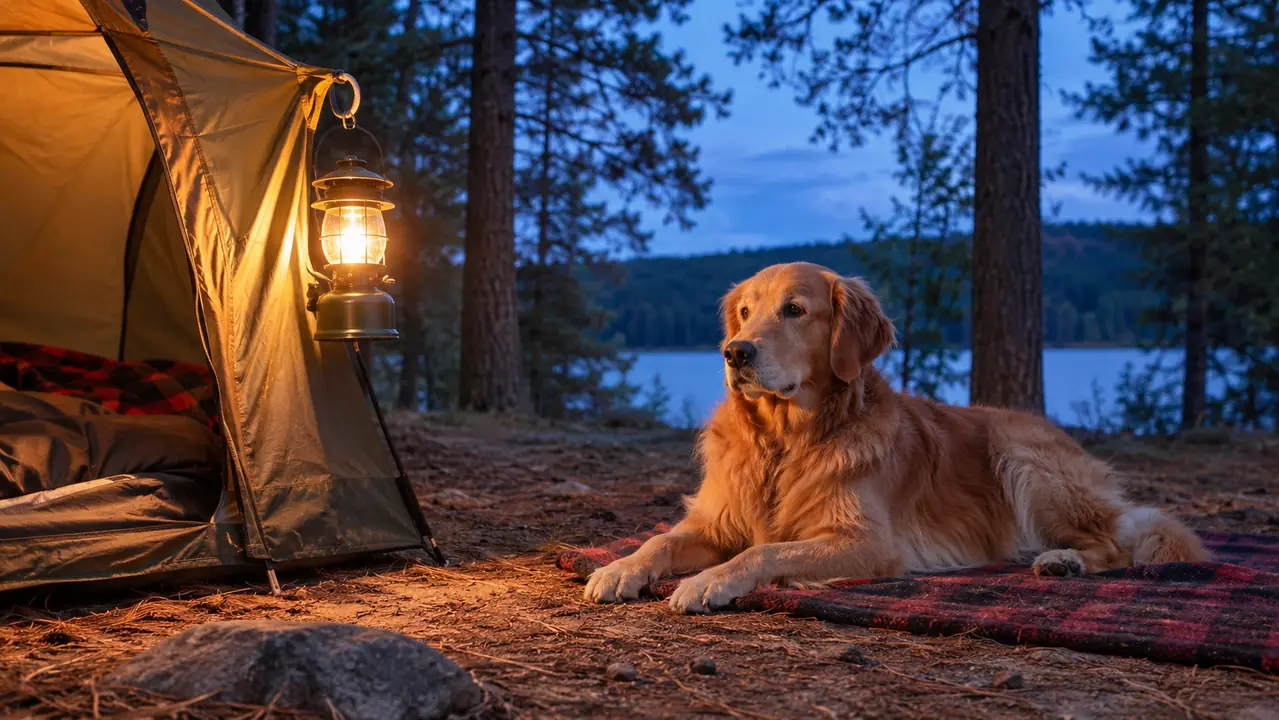
The first night I hung the Lepro from the loop at the top of my tent, Biscuit stopped pacing. That sounds like a tiny thing. If you have camped with a dog that runs warm all afternoon and then gets restless and cold once the sun drops, you know it is not tiny at all. He is a 6-year-old Australian Shepherd mix, about 45 pounds, and he had spent two seasons telling me exactly what he thought of my old setup, which was a hand-me-down flashlight balanced on a duffel bag. Every time I rolled over, the light rolled with me. Every time the light moved, he got up to check on it. I bought the Lepro 1000LM LED Camping Lantern Rechargeable in April mostly because I was tired of buying D batteries, and it has gone on every trip since.
This is not a review written off a spec sheet. I am 58, retired from turning wrenches on school buses, and I camp out of a 2017 Subaru Forester at state parks in Tennessee and western North Carolina. Two or three nights at a stretch, spring through late fall. Ray comes along maybe one trip in four. The rest of the time it is just me and the dog. So what follows is a season of real nights, what held up, what annoyed me, and who I think ought to spend the money.
The Quick Verdict
Hangs solid, throws far more light than a tent can use, and dims down far enough to read by without waking the dog. The 12 hour figure is a best case, not a normal case.
Amazon Check Today's Price →One hook, one charge, and the tent stops being a cave
1000 lumens across a 360 degree beam, four modes, and a hook at the top and at the base so it hangs either way. Rated at 12 hours of runtime on the setting you will actually use after dark.
Amazon Check Today's Price on Amazon →How I've Used It
April through October, call it eighteen nights. Some were warm enough that I left the fly off. Some were the kind of cold that settles into the bottom of a hollow in the Smokies around two in the morning. The lantern hung from the top loop on every one of those trips, and on four or five of them it hung from a branch over the picnic table instead so I could cook and wash dishes without a headlamp strapped to my forehead.
What I wanted from it was simple. Enough light to find a dog bowl and a pair of socks at midnight. Not so much light that the whole loop can see into my tent. And a battery that does not need to be babied, because I am not going to remember to top anything off between Friday and Sunday. The Lepro does the first two well, and the third one with a caveat I will get to.
It weighs 550 grams, a little over a pound, and it lives in the driver's side door pocket of the Forester where I can reach it without unpacking anything. It has spent six months shoved in next to a tire iron and a roll of paper towels. That is not a torture test. It is just what actually happens to gear.
The night I remember best was a Friday in July at Harrison Bay. I pulled in at twenty past nine, well after dark, and the site was nothing but shapes and tree trunks. I reached over, popped the hatch, hung the lantern off the strut, and had the whole back of the Forester lit before I had my boots changed. Cooler, duffel, dog bowl, the bag with the coffee in it, all of it visible at once. Three minutes later I was in a chair with a cup in my hand instead of standing there with a flashlight in my teeth wondering where the tent stakes went.
What 1000 Lumens Looks Like Inside a Tent
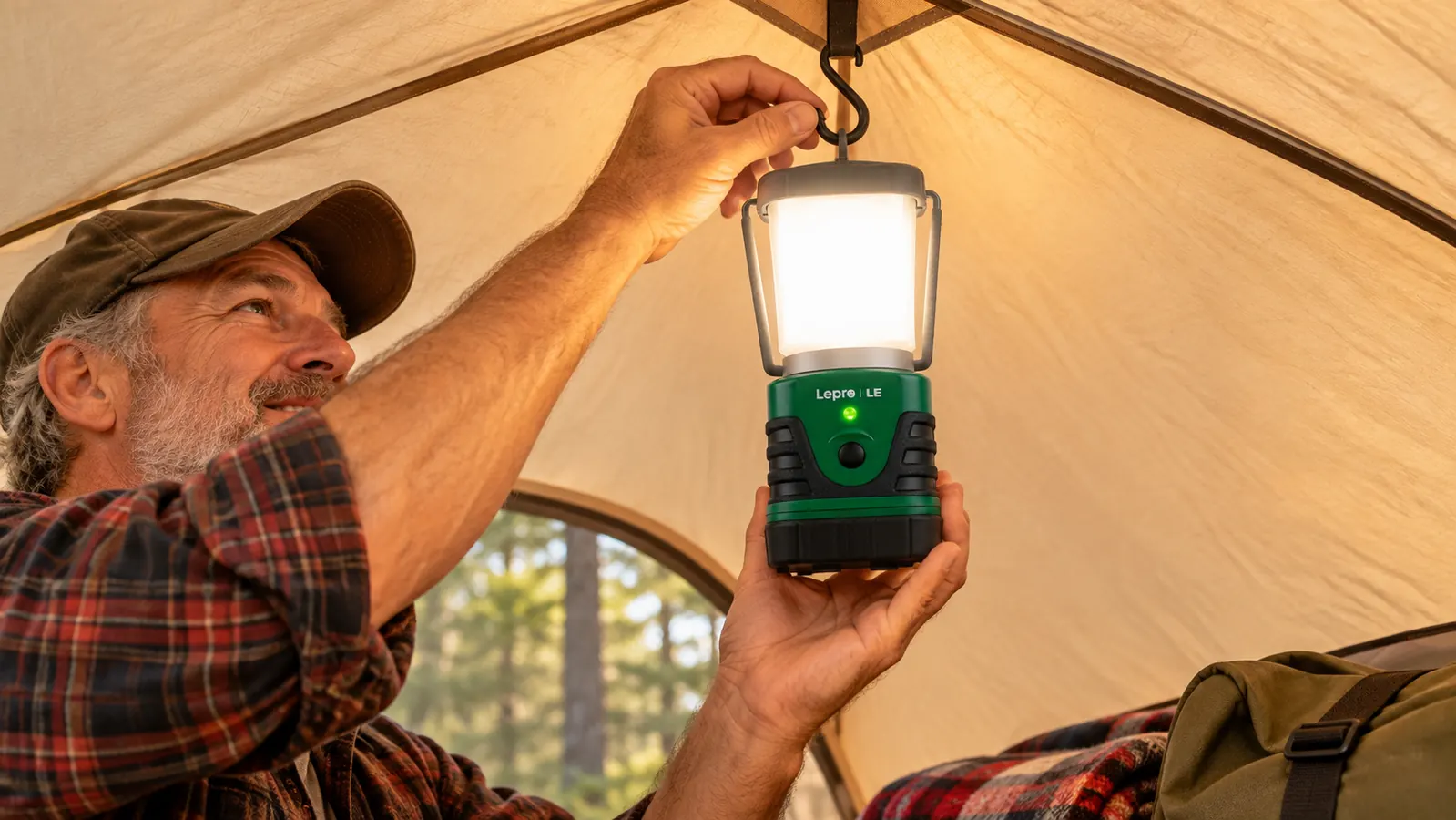
A tent is a small fabric box, and light in a small fabric box bounces around and comes back at you. The first time I turned this one all the way up inside a three person tent, I laughed out loud. It was too much. It lit the whole interior, the ceiling seams, the corner where Biscuit had pressed himself into a ball, and it threw enough through the mesh door to put a rectangle of light on the ground outside. A thousand lumens across a 360 degree beam angle is a serious amount of light for a tent. It is not too much for a campsite.
Where it earns its keep is outside. Hung from a branch or set on a picnic table, it covers a cooking area, a cooler, two chairs, and the patch of dirt where I put the dog's water bowl down. That last part matters more than it sounds. A dog moving around in the dark near a fire ring and near guy lines is a dog that is going to trip somebody. Being able to see the ground where he is standing is worth more to me than any line on the box.
The site I use most at Booker T. Washington has a picnic table, a fire ring about four steps off to the left, and a tent pad on the other side. Hung at head height from the low branch behind the table, the lantern reaches all three. I have cooked a full supper, washed a pot in a collapsible sink, and found a leash in the dark without picking up another light one single time. That is the test I actually care about, and it passed it in June and again in September.
If you want dim, it will dim. I read by the lower settings with the lantern hanging about two feet over my head and it does not glare, which is the thing cheap lights get wrong. The two light sources are arranged so the light comes out sideways as much as down, so hanging it above eye level is the difference between a comfortable page and a headache by nine o'clock.
A thousand lumens is too much for a tent and about right for a campsite. The part that matters is that it lets you choose, and the low setting is where I spend most of my nights.
The Four Modes and How Long They Actually Last
There are four modes, and I will be honest about how I use them, which is that I use two. There is a bright end and a dim end with a couple of stops in between, and my whole routine is to run it high for ten minutes while I set up, then drop it down for the rest of the evening. In eighteen nights I have never needed anything beyond those two.
The battery is 4400mAh and Lepro rates runtime at 12 hours. On the setting I use after supper, which is near the dim end, I get through a two night trip and come home with something left in it. On high, no. High is a ten or fifteen minute setting, not an all evening setting. Run it wide open from dusk until bedtime and you will be charging it the next afternoon. That is not a flaw, it is just how light output and battery capacity work together, and the 12 hour number is a best case rather than an average.
The other caveat is that the batteries are built in and rechargeable. There is no swapping in a fresh set at camp and no rack of disposables in the tote. You charge it from a cable and you plan around that. For car camping out of a Forester it is fine, and it is the reason I stopped buying D cells in the first place. For a trip where you will not see an outlet for four days, it changes the math.
Hanging It, Rain, and the Small Stuff
There is one hook on the top and one hook at the base. That reads like a bullet point until you use it. The top hook is how it hangs in the tent. The base hook is what lets you hang it upside down from a low branch over a picnic table, or from the open tailgate of the SUV. Upside down puts the light on the table instead of in your eyes. I did not expect to care about that and I care about it a good deal.
Water resistance is rated. That is not the same as waterproof, and I treat it that way. I have had it out in two steady rains and one proper mountain downpour and it kept working. I would not leave it sitting in a puddle overnight and I would not drop it in a creek. The plastic body has a few scuffs now and the seams are still tight. Nothing has cracked. It also does not get hot enough to worry about when you grab it, which I cannot say for an old mantle lantern I used to own.
The night it got tested properly was a Saturday in August at Standing Stone. A storm came through around ten, the kind that turns a tent into a drum and makes you check the guy lines twice. I had left the lantern hanging from the top loop with the fly open because I was still reading. It took rain for the better part of an hour. I wiped it down with a towel the next morning and it came on the first time I pressed it. No fog under the lens, no flicker, no water sitting in the seam. I would not push my luck twice, but that told me what I wanted to know.
What I Don't Love
Two things, and neither is a dealbreaker. The first is the top hook. It is small. It fits the loop sewn into my tent just fine, and it does not fit over the thicker branch I wanted to use on one trip in the Nantahala, so I ended up hanging it from a strap instead. A slightly bigger hook would be an easy improvement and would make the thing more useful around camp.
The second is that brightness and runtime are the same fact told two ways, and I wish the packaging said that more plainly. Twice this summer I turned it all the way up to dig something out of the bottom of a tote, got distracted, and came back an hour later to a noticeably dimmer lantern. That is on me, not on Lepro. But the honest framing is that this is an evening lantern with a bright setting for short bursts. It is not a work light.
How It Compares to What I Carried Before
Before this I carried a flashlight and a battery lantern that took four D cells and put out a fraction of the light. The D cell lantern ate batteries and seemed to save its dying moments for the worst possible time. The headlamp stays in my kit and always will, because I need both hands free when I am managing a leash and a dog in the dark. But the headlamp lights where I look and the lantern lights the camp. Those are different jobs and I got tired of asking one tool to do both.
The other thing that changed is the dog. Biscuit settles faster with a steady, dim light in the tent than he does with a beam swinging around every time I move. I do not have a study for that. I have two seasons of a dog who used to be up three or four times a night and is now up once, usually around the time I get up anyway. Take that for what it is worth, which is one woman's experience in one tent.
What I Liked
- Hangs two ways, from the top hook or upside down off the base hook
- 1000 lumens across a 360 degree beam covers a whole campsite, not just a tent
- Low settings are dim enough to read by with no glare
- Built in rechargeable batteries, so no rack of D cells in the tote
- Rated water resistant and it rode out real rain without a complaint
- Handles a two night weekend on the low setting without a recharge
Where It Falls Short
- The 12 hour runtime is a best case, and high output burns through it fast
- Top hook is small and will not fit a thick branch
- Built in batteries mean no swapping in a spare set at camp
- More light than a tent can use, so you are paying for the outside setting
Who This Is For
Car campers, mostly. People who pull into a site at dusk and want light on the ground thirty seconds after they open the tailgate, instead of ten minutes of fumbling with a flashlight in their teeth. Dog owners especially. If you have ever had a 45 pound animal decide the guy line is a thing to investigate at eleven at night, you already know why a lantern that covers the whole site is worth more than a brighter beam pointed at one spot. And anyone who is done with disposable batteries will like this more than they expect to.
I would also say this to anyone building a first camp kit for a couple: buy one lantern instead of two flashlights. Two flashlights in one tent means two people moving two beams, and a dog who cannot settle because the shadows keep changing every time somebody rolls over. One lantern hung above head height solves a problem that two flashlights quietly create. It took me two seasons and a lot of lost sleep to work that out, and I would rather you heard it from me.
Who Should Skip It
Backpackers. At 550 grams it is not a weight you carry on your back for eight miles, and there are lighter options for that job. Also skip it if you want a light that runs on AAs you can buy at a gas station, because the batteries here are built in and that is the whole design. And if you need something that stays on high for six solid hours while you work on a project after dark, this will disappoint you, and honestly a proper work light would serve you better. For camp light after supper, it is the right tool.
Eighteen nights, a dog who finally sleeps, and one charge between most trips
1000 lumens, 360 degree beam, four modes, and hooks at both ends so it hangs right side up in the tent and upside down over the table. It has lived in my door pocket since April.
Amazon Check Today's Price on Amazon →