
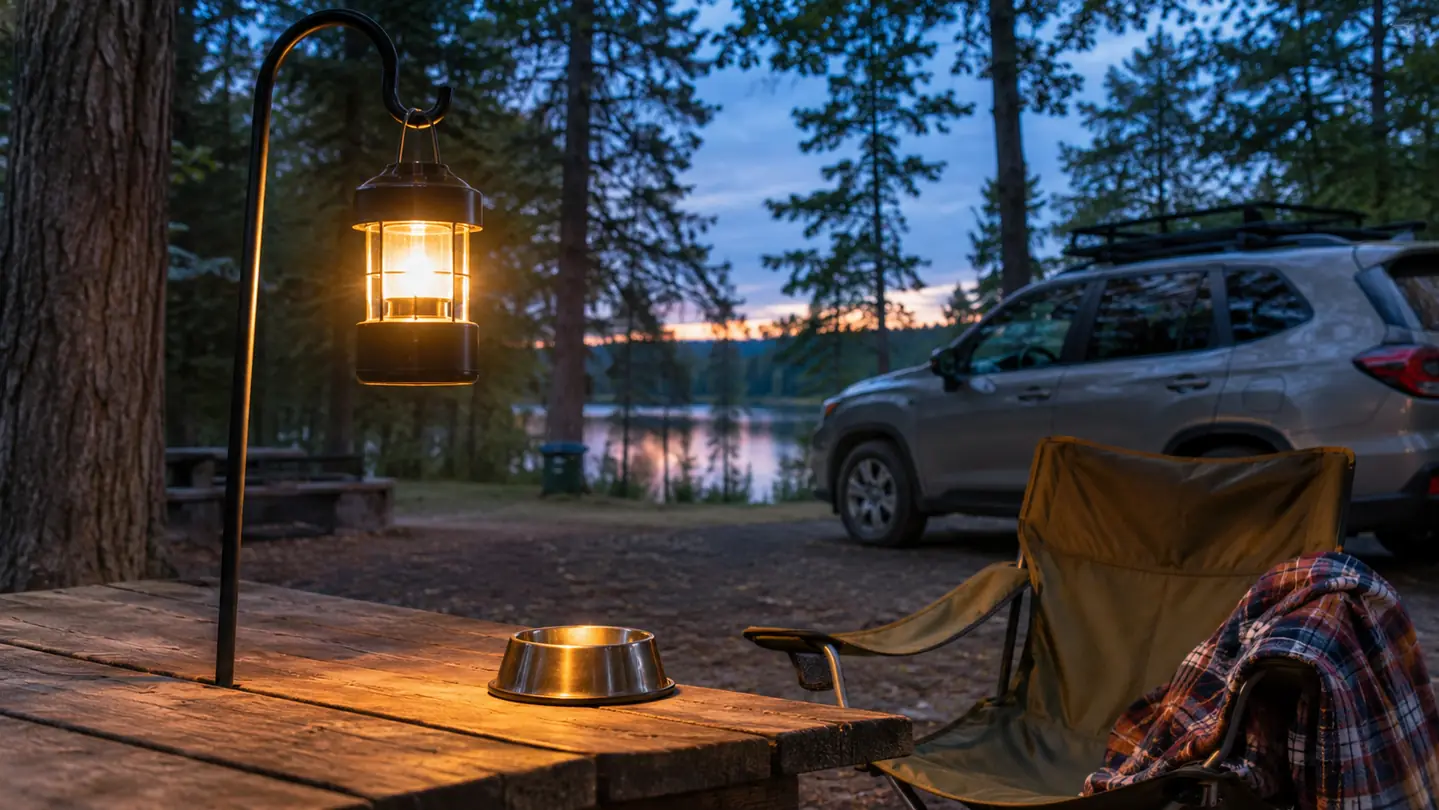
I used to be a flashlight person. Thirty years of turning wrenches on school buses taught me to carry a light in my pocket, and that habit came right along to the campground. For my first few seasons camping out of the Forester, a flashlight was the only light I brought. Then I spent one long October evening chasing a beam around a picnic table while Biscuit stood in the dark waiting for me to find his water bowl, and I decided I was done.
What replaced it was a Lepro 1000LM rechargeable lantern. Not because I read a spec sheet and got excited, but because a woman two sites over had one hanging from her pop-up canopy and I could see her whole camp. That is the difference in one sentence: a flashlight lights what you point it at, and a lantern lights the place you are standing. Here are ten reasons that matters more than I expected.
The light I hang once and forget about until morning
1000 lumens, four modes, and a hook on top and bottom so it hangs from a canopy, a tent loop, or a branch.
Amazon Check Today's Price on Amazon →You get both hands back
This is the one that sold me and it is not close. With a flashlight you are holding something, which means one hand is always busy. Try opening a cooler, zipping a tent flap, or clipping a leash onto a wriggling dog with a flashlight in your fist. The Lepro hangs from the hook at the top of the tent door or the loop on my canopy and just sits there being bright. I set it up once at dusk and my hands are free for the rest of the night.
The whole camp gets lit, not one spot
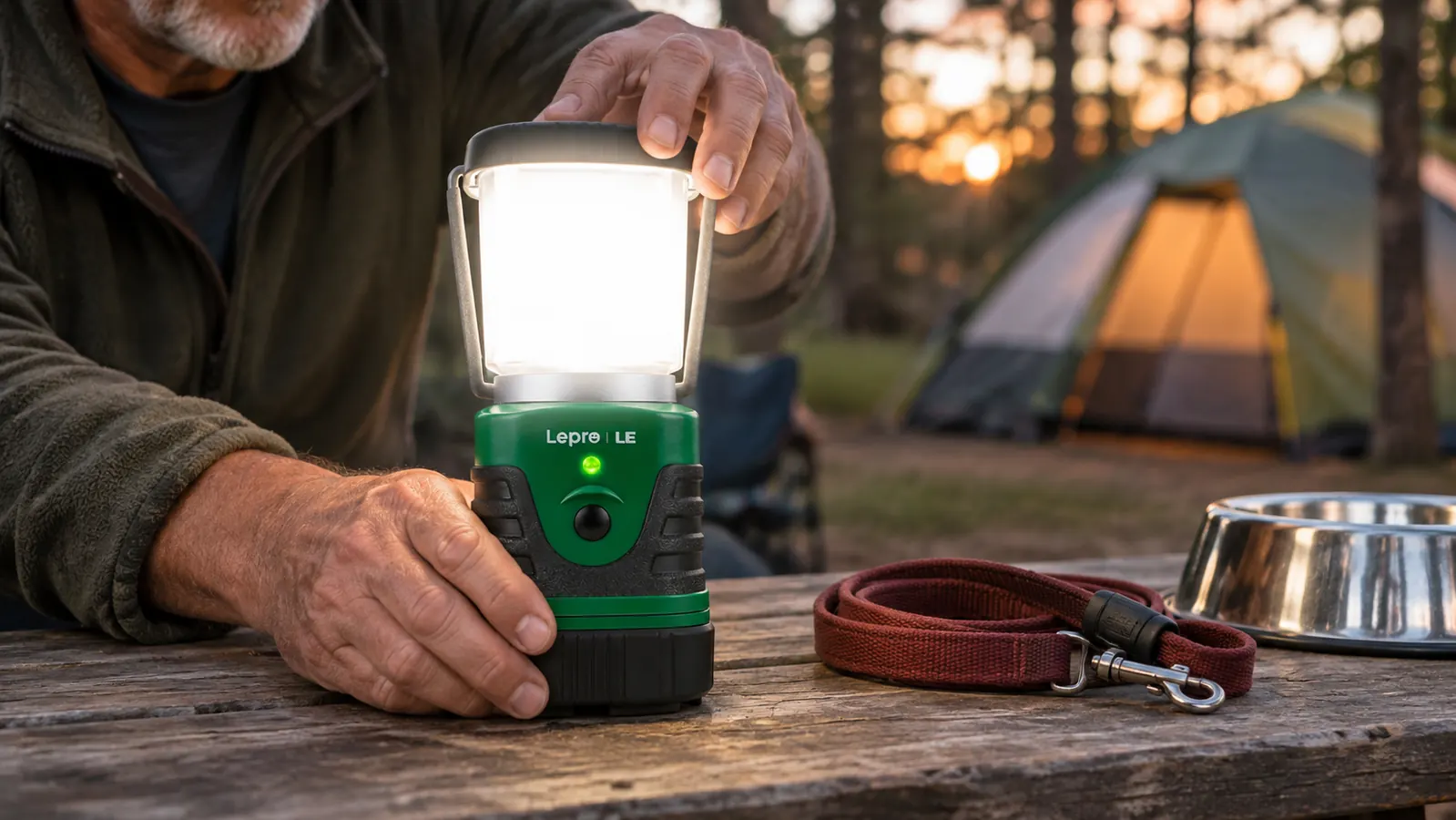
A flashlight throws a narrow beam. Everything outside that circle is dark, which is why flashlight campers are always swinging the beam around like a searchlight. The Lepro has a 360 degree beam angle, so the light goes out in every direction from where it hangs. Standing at the table, walking to the cooler, finding the dog's leash, all of it happens inside the light instead of at the edge of it.
Biscuit stops standing in the dark
My dog is a six-year-old Australian Shepherd mix, about 45 pounds, and he gets restless once the sun drops. He wants to know where I am and where his bowl is. With a flashlight, he is lit for two seconds and then dark again. With the lantern overhead, he can see his water bowl and his mat without me aiming anything at him. He settles faster. I did not expect a light to change a dog's behavior, but a dog who can see is a dog who lies down.
It runs 12 hours on a charge
The battery life on this thing is rated at 12 hours, and on the lower settings I have never come close to draining it over a two or three night weekend. It charges off the same cord as my phone in the car on the drive home. A flashlight with a dying battery is a paperweight. A lantern that still has hours left on night two is just a light you stop thinking about.
Four modes cover the whole evening
I use the low setting for dinner and conversation, the brighter setting for cooking and cleanup, and I save the full 1000 lumens for the walk to the bathhouse. Having four modes means I am not squinting or blinding myself depending on the hour. A flashlight has one mode and one answer, which is usually too much light pointed at the wrong thing.
It survives a wet October night
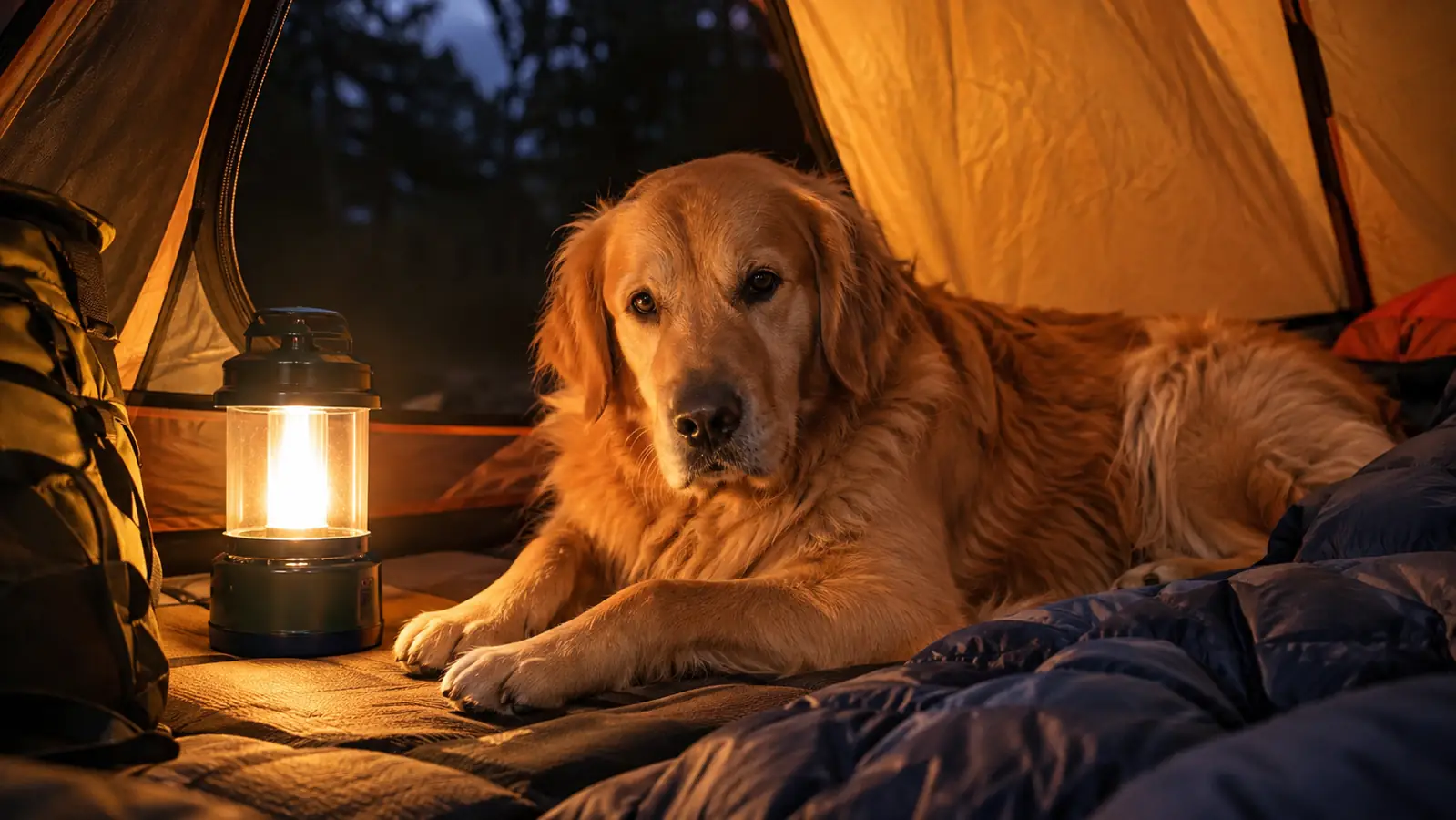
The Lepro is water resistant, and I have tested that without meaning to. A front came through a Tennessee state park in October and my lantern sat out under the canopy edge getting misted on for two hours. It came on the next morning without a complaint. I am not saying leave it in a puddle, but a light that lives outdoors needs to handle damp and this one does.
The dog can find his own way back
Biscuit is off leash in camp when the rules allow it, and he wanders the way herding dogs do, checking the perimeter. When I call him back after dark, a lantern gives him a landmark to walk toward. A flashlight gives him a blinding beam in the eyes. He comes back to the light now instead of circling the beam. Anybody who camps with a dog will understand why that is worth mentioning.
It hangs from a branch, a loop, or nothing at all
There is a hook on the top and another at the base, so it hangs from a canopy, a tent loop, or a low branch, and it sits flat on a picnic table when I want it there. It weighs 550 grams, which is about a pound, so I do not notice it in the tote bag. It is not a flashlight I have to hold, it is a light I place, which is a different relationship with the thing.
Charges in the car, no batteries to buy
It runs on two included lithium-ion batteries and charges over a standard cord. I plug it into the Forester's outlet on the drive out and it arrives full. I have not bought a pack of D cells in three seasons, and I do not miss the ritual of discovering a flashlight is dead at exactly the moment I need it.
One light does the job of the flashlight and the tent light
Before this, I packed a flashlight for walking and a separate small light for inside the tent. Now the Lepro hangs in the tent doorway at low setting while I read, and comes down to walk with me. One item in the bag replaced two, and I stopped digging for the one that still had charge.
A flashlight lights what you point it at. A lantern lights the place you are standing, and after dark that is the whole difference.
What I'd Skip
I still carry a small flashlight in my jacket pocket and I would not tell anyone to leave theirs home. It is the right tool when you are walking a trail after dark and want a beam down at your feet, and the lantern is not that. What I would skip is the habit of treating a flashlight as the main camp light. Pointing a beam at everything you need to see is a job, and after a day of hiking and a plate of dinner, I would rather hang a light and be done with it. If you want the longer version of how this thing held up over a full season, I wrote that up separately, and there is also a straight comparison against the Coleman LED I used for years.
Hang it once. That's the whole setup.
1000 lumens, 360 degrees, 12 hours of runtime, and a hook on both ends. It has been my only camp light for three seasons.
Amazon Check Today's Price on Amazon →