Biscuit is a 45-pound Australian Shepherd mix with a herding dog's opinion about property lines, and the first time I staked her out at a state park she wrapped the cable around the picnic table, then around my camp chair, then sat down and gave me a look like I had built the whole thing wrong. Nothing was broken. She was not in any danger. But I spent twenty minutes of a Saturday morning untangling a dog instead of drinking my coffee, and I decided that tying a dog out at camp is a skill, not a piece of gear you drop on the ground and hope about.
I camp out of a 2017 Subaru Forester most weekends from April into late October, mostly Tennessee state parks and the national forest campgrounds in western North Carolina, two or three nights at a time. Usually it is just me and Biscuit. Ray comes along when he can get away. After a few seasons of trying different setups, the one that has stayed in the Forester is the Supet dog tie out cable and stake: a 10-foot stainless cable, 5mm thick, wrapped in a vinyl coating, with a 360-degree swivel ring at the top and a screw-in stake rated for dogs up to 125 pounds. That swivel ring is the part that ended my tangling problem. The rest of this is the part nobody tells you, which is how to set the thing up so it actually holds.
The 10-foot setup that ended my twenty-minute untangling sessions
Supet builds this one as a 10-foot stainless cable with a vinyl coating that stands up to biting and weather, a 360-degree swivel ring that keeps the line from winding up, and a screw-in stake rated for dogs up to 125 pounds. Set it once at the edge of your site and let the swivel do the rest.
Amazon Check Today's Price on Amazon →Step 1: Read the Campsite Before You Screw the Stake In
Stand at the spot you are considering and look up before you look down. Dead limbs are common in state parks, and a dog staked to the ground under one has no way to get out of the way when it comes down at two in the morning. Once you are satisfied nothing is hanging over you, look around at ground level. How far is the fire ring, the road, the water, the next site's dog, and the path the camp host drives at dusk?
Then read the rules, because they vary more than people expect. Several Tennessee state parks cap leashes at six feet in developed areas, and a few require a hand-held leash at all times around the campground loop. A 10-foot cable is a fine tool for the space around your own site and a poor one for the walk to the bathhouse. If the rule is six feet, use six feet and save the longer setup for the back of your site where the dog can settle without entertaining the whole loop.
The last thing I look at is shade and ground. Biscuit runs warm and will pull against a cable all afternoon to reach the one patch of shade she can see. If I can put the stake where the shade lands at three o'clock, I do. If the site is wide open, I set up on the shaded side of the Forester, which is where she ends up anyway.
Two summers ago I pulled into a site outside Townsend, Tennessee at 7:40 in the evening with about twenty minutes of light left, and the first flat spot I liked had a black walnut limb the width of my arm hanging over it. I did not see it until I stood back and looked up, because I had been looking at the ground and thinking about dinner. I moved the whole setup twelve feet toward the fire ring and slept fine. That limb came down in a storm three weeks later, on a site two loops over. I look up first now, every time, even when I am tired and it is almost dark.
Step 2: Set the Stake So It Cannot Walk Out
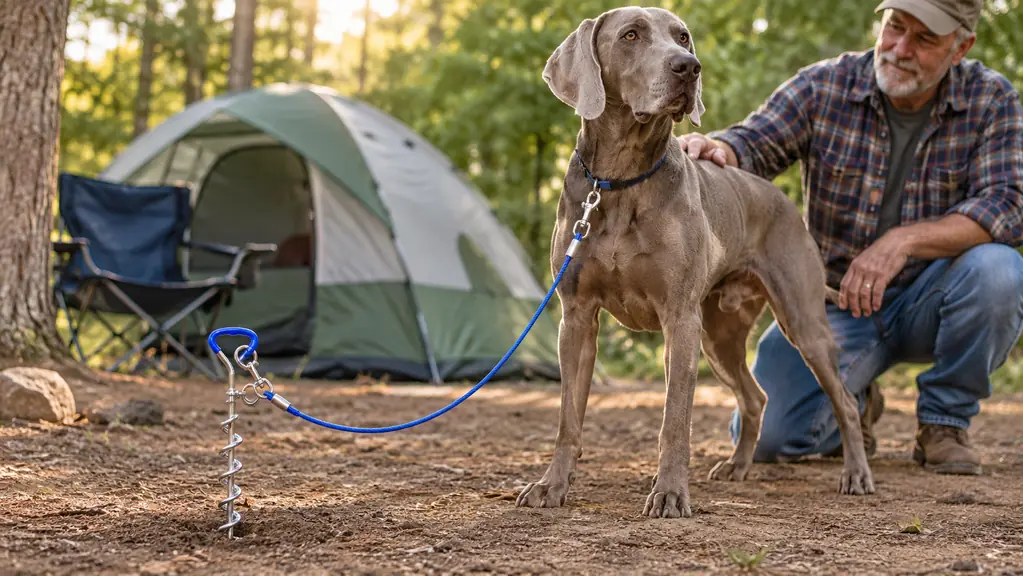
The stake that comes with the Supet cable is a screw-in style, and screw-in stakes fail for one of two reasons: the ground is too hard for them or too soft. Clear the grass and the top inch of soil first. Roots and buried rock will stop the screw, or worse, let it go in at an angle and feel tight when it is not.
Screw it in until the top of the stake sits just above the soil line, then position the cable so the pull comes from the direction the dog will actually pull. Do not trust it because it feels tight. Take the end of the cable in both hands and pull hard, three or four solid tugs from different angles. If the stake rocks or lifts, move six inches and start again. Two minutes here saves you a night of lying awake listening.
If the ground will not take a stake at all, do not force it. Two autumns ago, on a gravel pad outside Boone, the clay under the crushed stone was so hard the stake went in about an inch and then spun. I tried leaning a rock against it and told myself that would hold. I did not believe it, and I was right not to. I moved the setup to the packed dirt at the back edge of the pad, eight feet from where I wanted it, and it held through two nights of rain. The whole unit weighs about 1.32 pounds, so carrying it to a better spot is not a chore worth avoiding.
Step 3: Measure the Circle, Not the Dog
Ten feet of cable is ten feet of reach in every direction, and the reach matters more than the length. Before the dog goes on, walk the full circle yourself. I do this every trip and I still find something: a guy line I forgot about, a rock the cable will catch on, the edge of the fire ring, the corner of the cooler.
What you are looking for is anything the dog can reach that can hurt her or that she can pull over. The stove. A cooler with food in it. A folding table. The tent stakes. Then check for anything the cable itself can hang up on, because a cable under tension across a root or a rock will wear through its coating a lot faster than one running clean.
On one site the picnic table sat about eight feet from where I wanted the stake, which put the near leg comfortably inside the circle. Rather than drag the table, which the park frowns on, I moved the stake four feet closer to the tent. I lost some room, but a small clean circle beats a big one with three hazards sitting in it, and Biscuit never noticed the difference.
The 360-degree swivel ring at the top of this cable keeps the line from winding up as the dog circles the stake, and on a 45-pound dog that changes direction every thirty seconds, it earns its keep. It does not fix a bad location. A swivel ring cannot untangle a cable from a picnic table the dog should not have been able to reach in the first place.
Step 4: Make the Cable the Good Part of the Day
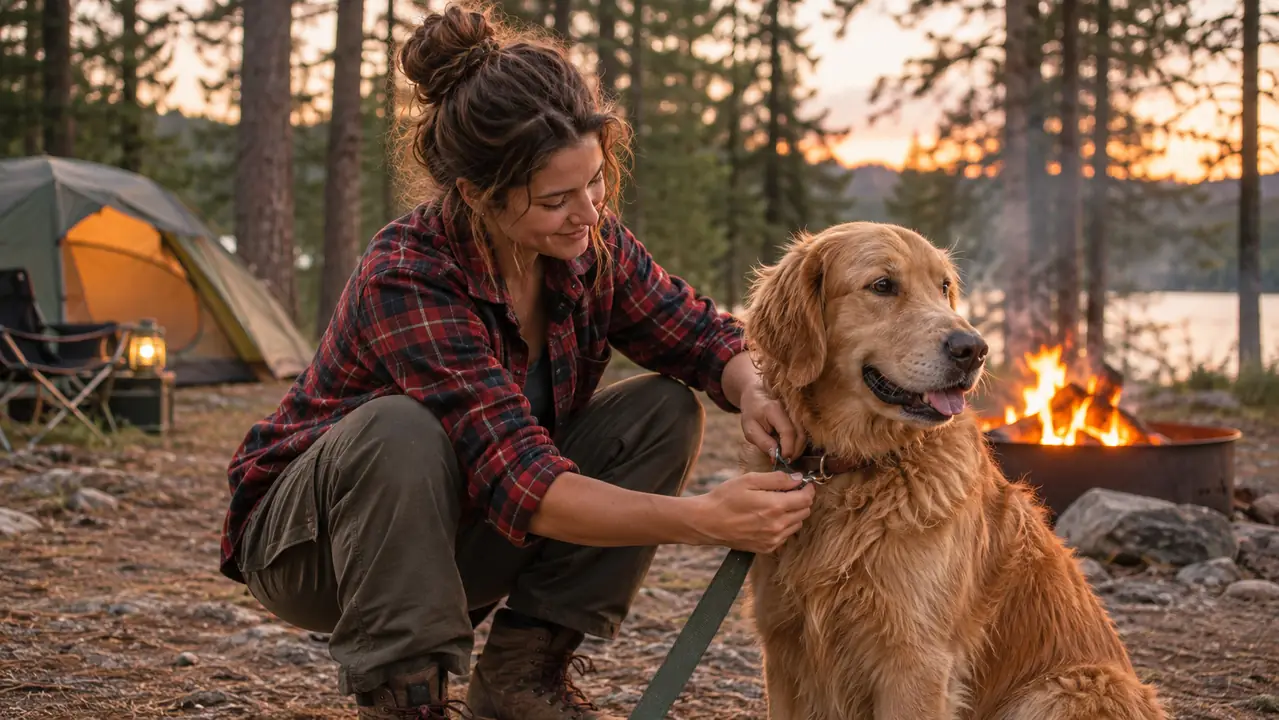
A dog that only gets tied out when the humans want to sit still learns that the cable is the boring part of the afternoon. Biscuit gets attached with a piece of something good in her bowl, and I stay within sight for the first ten minutes. She settles in about that long now. On the first trip of the season it took closer to half an hour, and she complained about most of it.
Water goes inside the circle, not just outside it. Shade if the site has any. A chew or a mat helps a dog that is used to patrolling a yard and does not understand yet why this one has a boundary.
I also do not attach her and wander off for an hour. Plenty of campgrounds prohibit leaving a dog unattended, and even where it is allowed, a tied dog that cannot get away from a loose dog or a kid cutting through has no options. The cable is for the times I am right there, which is most of the weekend.
Step 5: Do a Morning, Afternoon, and Bedtime Check
The vinyl coating on this cable is there to take the chewing and the weather, and it is worth running your hand down the length of it once a day. A cracked spot, or a spot chewed down to the steel, is a reason to retire the cable. It is not a reason to watch it more closely.
Check the stake again after rain. Ground that held like concrete on Friday can be soft by Saturday afternoon, and a stake that was solid in dry dirt will pull out of wet dirt with half the effort. In June a front came through on a Saturday afternoon and dropped about an inch of rain in forty minutes. The stake I had set on Friday morning came out with one hand that evening. I reset it ten inches away in ground with better grass holding it and it stayed put the rest of the trip. That is the entire reason the recheck exists: the ground changes while you are not looking at it.
At bedtime, the cable comes up. Bring the dog into the tent or the vehicle. Overnight is when the campground goes quiet, wildlife moves, and nobody is awake to notice a problem. Most of the parks I stay in require it anyway, and Biscuit sleeps better in the tent than she does tied out in the dark, especially once the temperature drops after sundown.
What Else Helps
A few small things make the tie out work better. A water bowl set inside the circle, so the dog does not have to pull to the end of the cable to drink. A cheap camp mat or a square of closed-cell foam, because a dog with a defined place to lie down settles faster than one hunting for one. I keep both in a tote that goes in the Forester first, before the firewood.
A quiet chew for the first twenty minutes after you attach the dog covers the window when a dog is most likely to test the setup. A tick check at the end of the day matters too, since a dog staked at the edge of a site is standing in exactly the grass the ticks are in.
If you camp where the ground is unpredictable, a spare stake is not a bad thing to carry, and a short backup leash lives in the Forester regardless. That is not a knock on this setup. It is how I pack for anything I cannot fix at ten o'clock at night in a state park.
Ten feet of cable means ten feet of reach in every direction. Walk that circle yourself before you clip the dog on.
None of this is complicated. It just has to happen in the right order, and it has to happen every trip, including the trip where you are tired and arriving late and the light is going. Those are the trips where I have made every mistake in this article at least once.
Set it once, then go back to your coffee
The Supet tie out cable and stake is a 10-foot stainless cable, 5mm thick with a vinyl coating, a 360-degree swivel ring, and a screw-in stake rated for dogs up to 125 pounds. It has done two seasons of weekends in the Forester without a wrap, a tangle, or a pulled stake.
Amazon Check Today's Price on Amazon →