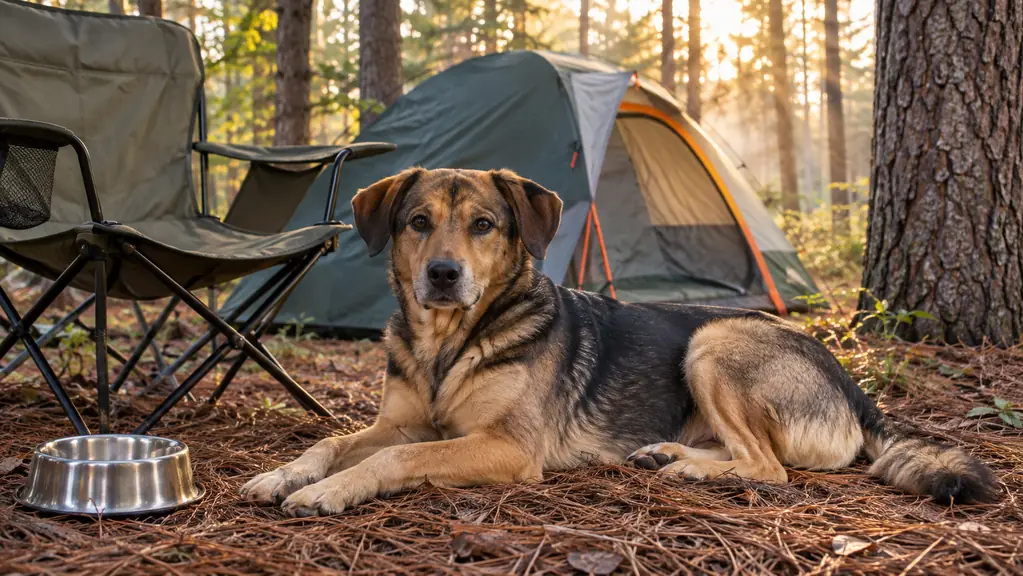
Camping with a dog is easy right up until the moment you need both hands. That is the whole problem in one sentence. You need both hands to haul the cooler out of the Forester. Both hands to get the stove lit before the coffee water boils. Both hands to wrestle a rain fly over the poles while the sky goes from gray to serious. And in the middle of all that, a forty five pound dog who has decided the family two sites over is the most interesting thing in Tennessee. I spent two seasons doing the one knee and a loop of rope trick before I bought a Supet dog tie out cable and stake. It is not a fancy piece of gear. That is the point.
Biscuit is six, an Australian Shepherd mix, and he is not a bolter. He is something more annoying than that. He is friendly and curious and he wanders with total confidence, three feet at a time, until he is suddenly forty feet away inspecting somebody's breakfast. I tried a long training lead and my own foot as an anchor. I tried tying off to the picnic table, which he wrapped himself around twice in under a minute. What finally worked was a cable with a stake that screws into the ground and a ring that spins. Supet makes the one that lives in my crate now. Here are ten reasons it earned that spot.
The smallest thing in the crate did the most work
Ten feet of coated cable, a screw stake and a swivel ring. That is the entire product, and it is the reason I cook dinner with both hands now instead of one.
Amazon See the Supet tie out on Amazon →The Ten Reasons, In the Order They Mattered to Me
Ten feet of slack covers the whole camp kitchen
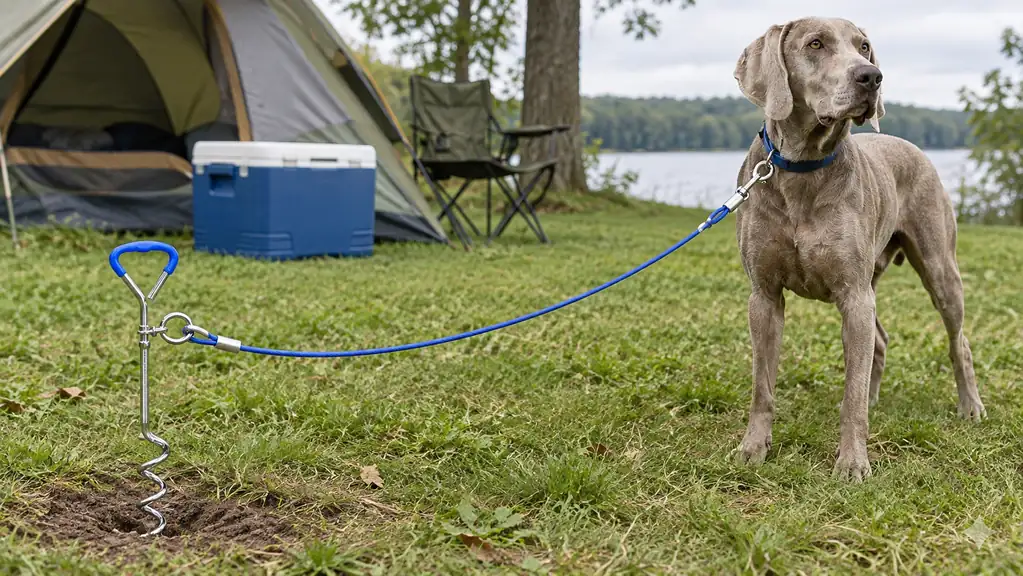
The cable is 10 feet long, and that number sounds small on paper. In practice it is the distance from the stake by the fire ring to the cooler, the stove table, and the tent door all at once. I twist the stake into soft ground, hook Biscuit up, and he can lie in the shade, get up, turn around twice, and lie back down without me touching anything. Before this I was stepping over a rope every thirty seconds. Now I forget he is attached until he stands and looks at me.
The screw stake holds where a straight peg walks out
State park ground can be sand, gravel, red clay, or a mat of roots, sometimes all in the same site. I have watched a straight tent peg pull free on the first fuss of a rope. The stake that comes with this one screws down into the dirt instead of driving straight in, and that is the difference on a dog who leans. I set it with a twisting push, stood up, and it held through two nights of Biscuit doing his circling routine at the end of the cable. Nothing came loose either night.
The 360 degree swivel ring ends the wrap around the table leg
This is the reason I stopped fighting with the tie out every ten minutes. A fixed clip plus a spinning dog equals a twisted cable and a dog stuck facing a tree. With the swivel ring, Biscuit goes left, goes right, circles back toward me, and the cable unwinds itself as he moves. I have not once had to walk over and untangle him. If you have ever spent a weekend unwinding rope while your coffee went cold, you know exactly how much that is worth.
The vinyl coating survives a dog with opinions
The cable itself is 5mm thick, wrapped in a vinyl coating that resists biting and corrosion, and the core is stainless steel. Biscuit is not a destroyer but he is a worrier, and he mouths things when he is bored and it has been raining since noon. Two seasons in, the coating is scuffed at a couple of spots and the cable underneath is sound. It also does not hold mud and water the way bare rope does. I shake the Supet cable off, coil it, and it goes back in the crate without dirtying everything around it.
It weighs a little over a pound, so it never gets left at home
One point three pounds, about the heft of a paperback, and it coils into a loop roughly the size of my hand. That matters more than it sounds like it should. Gear that is a nuisance to pack is gear that stays in the garage. This one lives in the tote with the spare stakes and the tarp lines, and I have never once decided it was not worth the space. On a quick overnighter it still comes along, because adding it costs me nothing.
Two seasons of weekend trips and I have not once had to walk over and untangle him.
Setup takes about a minute, even by headlamp
First trip out I actually timed it. Screw the stake down, uncoil the cable, hook the dog. Somewhere around sixty seconds, and twenty of that was Biscuit trying to help. Nothing about it needs a second person or a lesson. If you roll into a state park at dusk, which I do more often than I plan to, that minute is the difference between eating supper at a reasonable hour and eating it with a flashlight clamped in your teeth.
It gives you a second set of hands at the stove
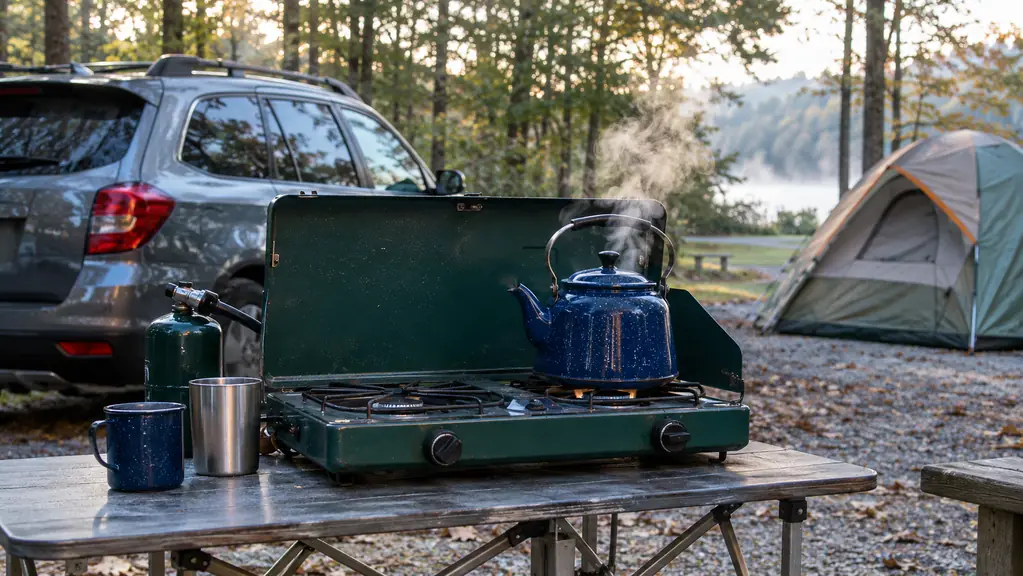
This is the real reason I keep it, and it has nothing to do with containment. Ray does not come on most trips, so at camp it is me and Biscuit and a pot of boiling water and a folding table with a wobble in one leg. With the stake in, Biscuit is on his own patch of ground doing his own business and I have both hands free for the stove, the tent stakes, the food bag line, and the doors on the Forester. Nothing dramatic about it. I just finish setting up camp without losing my temper.
It is quieter than chain at two in the morning
I camp in state park loops with other people in them, and I would like to be invited back. Chain drags on itself every time the dog shifts. A coated cable does not. When Biscuit moves at 2 a.m. looking for a better spot on the pad, I hear one small click and then nothing. My neighbors have thanked me for less. If you are the person lying awake worrying that your dog is being the loud one in the loop, this is a small mercy you will notice on the first night.
The same setup works in the yard, so the dog already knows it
The listing calls it a tool for the yard, camping, the park, traveling and hiking, and I have used it for at least three of those. That matters for training more than for gear. Biscuit learned what the cable means at home, in my own yard, where nothing exciting was happening and I could correct him calmly. By the time we got to a campground full of squirrels, the rules were old news. A dog who meets a restraint for the first time in a busy loop on a Saturday is a dog who argues with it.
It is rated for dogs up to 125 pounds, so it grows with the job
It is built for large dogs up to 125 pounds, and Biscuit at 45 pounds is nowhere near the top of that range. I like that fine. I am not buying a new tie out every time a dog fills out, and I am not worried when my brother brings his Labrador to the next site over. The stake, the cable and the swivel are sized for a dog that actually pulls, not a decorative one. Two seasons of weekends and it is the piece of gear I have had the fewest thoughts about, which is what I want from gear.
What I'd Skip
One habit I would skip: staking it out as far from the tent as the ground allows. My first season I kept giving Biscuit more room, thinking he would enjoy the range. He did not. He spent the whole evening at the very end of the cable, staring back at the camp chairs, because a dog's idea of a good spot is one where he can see you. Now I set the stake eight or ten feet from my chair, with shade within reach, and he settles in minutes instead of pacing.
I would also skip treating it as a substitute for a fence, a crate, or your own eyes. It is a tether. It keeps a dog in one place while your hands are full, and it does that part well, but it is not supervision and it is not shade and it is not water. Biscuit comes off it whenever I leave the site, and he still sleeps in the tent with me. Where the campground has a leash rule, the cable does not replace the leash on a walk. It just gives him a place to be while the day happens around him.
If your dog spends the trip tangling and you spend it untangling
Ten feet of coated cable, a screw stake, a swivel ring, and about a minute to set up. The Supet tie out is the piece of camp gear I have had the fewest thoughts about in two seasons, which is the highest thing I can say about anything in my crate.
Amazon See the Supet tie out on Amazon →