
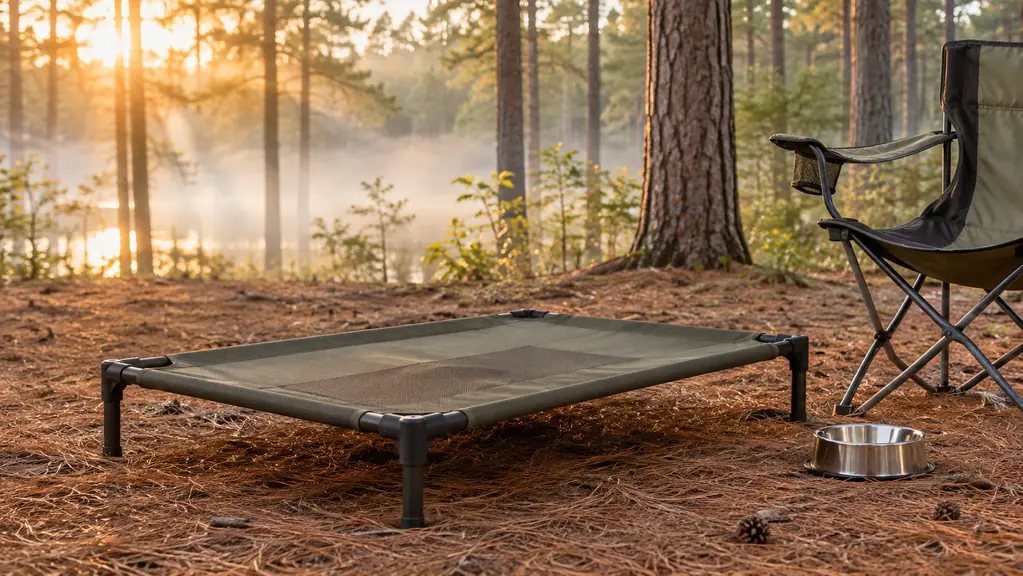
The first dog bed I brought camping lasted eleven minutes. Biscuit sniffed it, put one paw on it, got off, and went to sleep on the gravel beside the fire ring instead. I sat there with my coffee feeling like a fool. That was four years ago, and it took me three more seasons to understand what he was telling me. Dogs do not want soft in camp. They want cool, dry, and off the ground. The Veehoo Outdoor Elevated Dog Bed is the product that finally got that right for us, and this is the honest version of how it went.
I am not going to pretend this cot changed my life. It is a rectangle of mesh on a metal frame. What it did was solve a specific problem, which was a dog who would not settle at night unless he was off the dirt and in moving air. Below is what worked, what annoyed me, and the two things the product page never tells you. I have run it on eleven weekend trips since April, plus a month in the garage while my back was out and Biscuit needed somewhere off the concrete.
The Quick Verdict
Does the one job that matters in camp, which is getting the dog off the ground and into the breeze. The frame hums on hard packed gravel and the mesh is not chew-proof. Know those two things going in and it will serve you well.
Amazon Check Today's Price →The bed that ended the midnight pacing
Biscuit went from three wake-ups a night to one. The 42 by 30 inch Veehoo cot is the size that fits a 45 pound dog with room left to sprawl.
Amazon Check Today's Price on Amazon →How I've Used It
My setup is a 2017 Subaru Forester and a two or three night trip to a state park in Tennessee or western North Carolina. I am not backpacking. I pull up, I unload, and I have about fifteen minutes of patience for putting anything together. So the first thing I judge with gear is whether it goes up without a fight.
The Veehoo goes up without a fight. The frame pieces seat together and the mesh sleeve pulls over the ends. No tools, no bolts, no little bag of hardware to lose in the leaves. The first time took me about four minutes because I was being careful and reading as I went. Now it is under two, and I can do it in the dark with a headlamp, which I have done twice.
Before this cot I tried two other things, and both of them failed for the same reason. First was a folded moving blanket, which wicked up ground moisture and was heavy and cold and wet by morning. Then a self-inflating sleeping pad, which Biscuit put a hole in before the end of one season and which did nothing at all about heat coming up out of the ground. Neither one lifted him off the dirt. I understand now that lifting him off the dirt was the entire job, and I spent two years buying things that did everything except that.
The first night difference was bigger than I expected. On the ground, Biscuit shifts and circles and sighs and gets up to check the perimeter about every ninety minutes. On the cot he circles twice, drops, and is out. Same dog, same site, same weather. The only change was seven inches of air under him. I did not believe it the first trip. I believed it by the third.
One trip in particular sold me for good. Mid June, a Friday night at a state park outside Chattanooga, still 84 degrees at nine o'clock and not a breath of wind. The ground was throwing heat back at us like a brick oven. Biscuit would not lie down on anything I put out, blanket or pad or bare pine needles. I set the cot up in the shade of the Forester with the hatch open and he was on it before I finished seating the last corner. He slept through until five. I have not left it at home since.
Where the cot sits matters more than I expected. On grass or pine needles it is quiet and stable. On hard packed gravel it develops a small hum when the dog shifts his weight, because the frame is metal and the ground does not give back. I slid an old piece of closed cell foam under the two end bars and the noise stopped. That is a scrap from my sleeping pad, not a defect, but you should know it before your first night on a gravel pad.
What You Actually Get
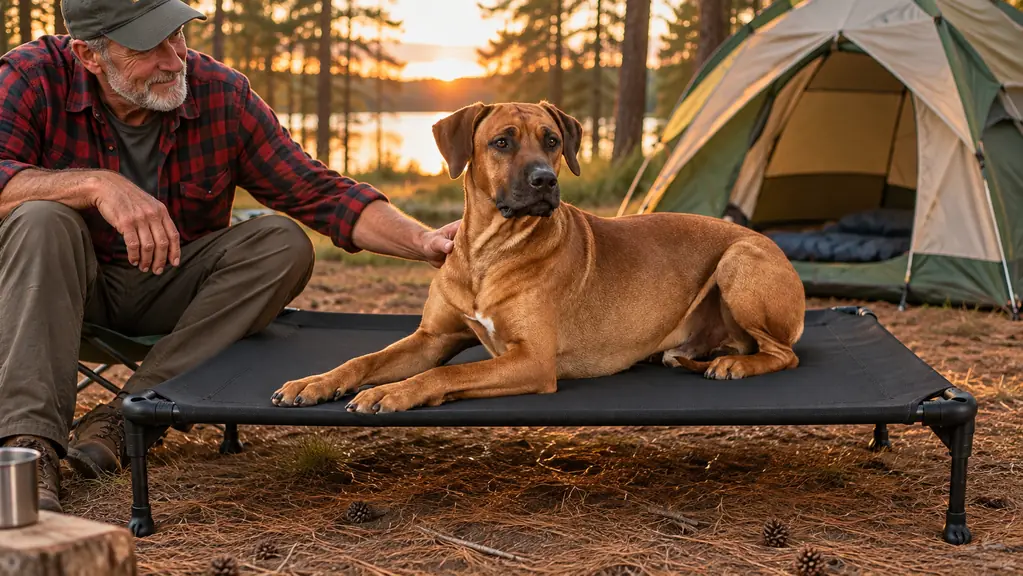
The cot measures 42 inches long, 30 inches wide, and 7 inches tall, and it weighs about six and a half pounds. Seven inches of clearance is the number that matters. It is enough for air to move under the dog, and on a warm evening that is the entire point. Biscuit runs warm. He has a heavy coat and he is moving all day. A bed that traps that heat against the ground is worse than no bed at all.
The sleeping surface is a Textilene mesh, which is the same family of material as the sling on a lot of outdoor chairs. It does not hold water. If it rains, or if the dog comes out of the lake, the water goes straight through and the surface is dry again in a couple of minutes. I have hosed it off at the spigot more than once and set it back up still wet. By the time I had my boots off it was fine.
Size is worth talking about, because people guess wrong here. At 42 by 30, this is the large version. Biscuit is a 45 pound Australian Shepherd mix and he can lie flat with his legs out and still have room. A bigger dog can curl on it. A much bigger dog, say a hundred pounds and up, will be hanging over the edges and you should look at a larger cot instead. Measure your dog nose to tail base before you order. It takes thirty seconds and saves a return.
The frame is metal with non-slip feet on the four corners. That non-skid bottom is doing real work on a camper floor. Biscuit steps onto this thing like he is getting into a truck, all front paws first, and the cot does not slide out from under him. On the Forester's rubber cargo mat it stays put too.
The Parts of the Listing I'd Rewrite
Here is where the honesty comes in, because a review that only lists good things is an advertisement with a byline.
First, the mesh is not chew-proof, and the listing does not claim it is, so I will just say it plainly. If your dog is a determined chewer, this bed will lose. The mesh has some give to it and teeth will find that give. Biscuit is not a chewer, so this has never been an issue for us. But I watched a friend's terrier mix go to work on a similar cot at a group site and it did not end well for the cot.
Second, the word cooling deserves context. The cot keeps the dog off the ground and lets air move underneath, and that genuinely helps. It is not refrigerated. On a 95 degree afternoon in direct sun the mesh is warm to the touch, like everything else in camp. The cooling happens in shade, in the evening, and in a breeze. If you read cooling as a device that does something, you will be disappointed, and that is a reading problem, not a product problem.
Third, and this is the one I wish was printed on the box, the cot assumes reasonably level ground. On a slope the whole thing racks and one corner lifts. It is not unstable, it is not self-leveling either. Look at your site before you pick the spot, the same way you would for a tent.
The bad site was a numbered pad at a national forest campground in western North Carolina, gravel over hard clay, sloping maybe four inches across the length of the pad. I set the cot down, Biscuit stepped on, and the whole thing rocked like a table with a short leg. I moved it twice before I found a flat enough patch over by the fire ring and slid a flat rock under one foot. That was ten minutes of my evening I had not planned on, and I was not gracious about it. Now I carry a square of plywood about a foot across in the cargo area, and I look at the ground before I unload anything else. Cheap fix for a real annoyance.
How It Held Up Over a Full Season
I keep a paper log in the glovebox, mostly for tire pressure and firewood runs, so I can tell you exactly how the season went. April was two trips, one to Fall Creek Falls and one close to home. May was three. June we lost a weekend to rain. July was two, both hot, both with the cot set up under the open hatch instead of out in the weather. August was one, because of my back, which is when the cot moved to the garage for a month and stayed set up on the concrete. September and October made up the rest. Eleven total, and the cot went up and came down on every single one.
The mesh has stretched slightly, maybe a quarter inch of sag in the middle, which is normal for a sling and has not affected anything Biscuit cares about. The frame joints still seat firmly with a push and a click I can hear across the site.
The feet are the part I expected to fail first. Four little non-slip caps on metal legs, and every one of them has been dragged across gravel, concrete, and one memorable stretch of red clay mud. All four are intact and all four still grip. That surprised me more than anything else on the cot, because rubber caps on camp gear usually go first.
The frame has a few scuffs where it rides against the cooler and the firewood in the back of the Forester. That is on me for not separating it. Nothing has rusted, and it has been rained on at least four times and left out overnight twice, once by accident.
Cleaning is the part that surprised me most. Mud comes off with a hose and a brush, and it does not hold smell the way a fabric bed does. My old padded mat smelled like a wet dog by Sunday morning no matter what I did with it. This one smells like nothing. That alone is worth something to anybody who has driven four hours home with a damp dog bed in the cargo area.
The one spot I would watch is the mesh where it wraps around the end bars. That is the highest stress point on any cot of this type. Mine still looks fine after a full season, but if it is ever going to fail, that is where it will start. Run your hand along it once a month and you will catch it early.
Setting It Up In the Dark
I mentioned this already but it earns its own note, because arriving after dark is normal for anyone with a job. The order is frame first, then slide the mesh over one end, then the other. Doing it backwards, meaning trying to stretch the mesh over a frame that is not fully seated, is how people tear things. Seat the frame. Then the fabric.
One of those dark setups was a Friday in late September. I pulled in at 8:40 after a long slowdown on I-75, and the loop was nearly full by the time I got there. I backed into the last open site, headlamp on my forehead, and had the cot up and Biscuit on it before Ray had the tent poles out of the bag. That is the honest test of any camp gear, whether it works when you are tired and it is dark and nobody is reading instructions. This one does. I have had gear that did not, and it lives in a tote in the garage now.
Teardown is faster. Pull the mesh off the ends, the frame collapses, and the whole thing goes behind the seat. It does not come with a bag. I use a mesh laundry bag I already had, mostly so the feet do not scuff the cooler on the drive home. Six and a half pounds is light enough to carry in one hand with a camp chair in the other.
What I Liked
- Seven inches of clearance and mesh that lets air move under the dog
- Goes together with no tools in under two minutes
- Water runs straight through and the surface is dry again in minutes
- Non-slip feet hold on a camper floor and a rubber cargo mat
- About six and a half pounds, easy to carry in one hand
- Does not hold odor the way a fabric bed does
Where It Falls Short
- Metal frame hums on hard packed gravel until you shim it
- Mesh is not chew-proof and will not survive a determined chewer
- Needs reasonably level ground or it racks at one corner
- No carry bag included
- A dog well over a hundred pounds will hang off the edges of the 42 inch version
Seven inches of clearance is the number that matters. It is enough for air to move under the dog, and on a warm evening that is the entire point.
Who This Is For
This cot is for the camper with a dog in the forty to eighty pound range who will not settle on the ground. If your dog runs hot, if he sprawls on tile at home, if he gets up three times a night in the tent, this is the fix. It is also for anyone who wants a bed that does not smell like a wet dog by Sunday morning, because the mesh does not hold odor the way fabric does.
It suits car camping, which is what I do. It does not suit backpacking at six and a half pounds and 42 inches long, though I have seen people strap stranger things to a pack and I am not going to tell you your business.
It also suits the garage and the porch. I bought this as camping gear and it has spent more nights set up at home than I expected, mostly because Biscuit likes it and it is easier to hose off than to wash a cover.
Who Should Skip It
Skip it if your dog chews. Skip it if your dog is a dedicated digger who goes after fabric with his front feet, because the mesh will not hold up to that. Skip it if you camp on steep ground and cannot be bothered to find a flat spot, because the racking will drive you up a wall by the second night.
And skip it if what your dog actually wants is a soft bed. Some older dogs with thin coats want padding and warmth and a mesh cot is the wrong answer for them. This is a cooling, off the ground bed. It is not a cushion. Biscuit has a fleece mat he uses in cold weather and this cot is what he uses the rest of the year. Most of us end up with both, and that is fine.
Off the dirt, in the breeze, asleep by nine
The 42 by 30 inch Veehoo cot is the size that fits a mid-size dog with room to stretch out. Compare it to what your dog is sleeping on now and see if it holds up.
Amazon Check Today's Price on Amazon →