
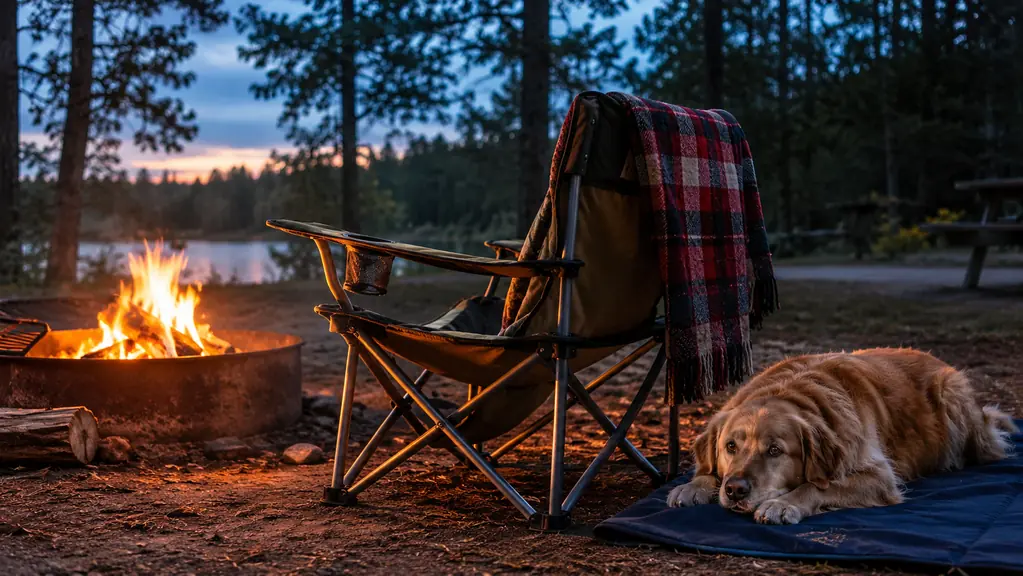
A folding camp chair looks like a solved problem right up until you have sat in one for three hours. Somewhere around hour two your lower back starts sending signals. By hour three you are shifting your weight every ninety seconds and hoping nobody notices. I have put two chairs in a campground dumpster for exactly that reason, and I did not feel good about either one.
I am Marla Quintrell. I am 58, I spent most of my working life as a school bus mechanic in Chattanooga, and I camp most weekends from spring through late fall at state parks in Tennessee and western North Carolina. I car camp out of a 2017 Subaru Forester with a 45 pound Australian Shepherd mix named Biscuit, who runs hot all day and gets cold the minute the sun drops. The chair I keep coming back to, season after season, is the Coleman portable camping chair with the four can cooler built into the arm. I will use it as the worked example here because I have actually sat in it for four seasons, not because it is the only decent chair on the market. It is not.
The chair I stopped replacing every spring
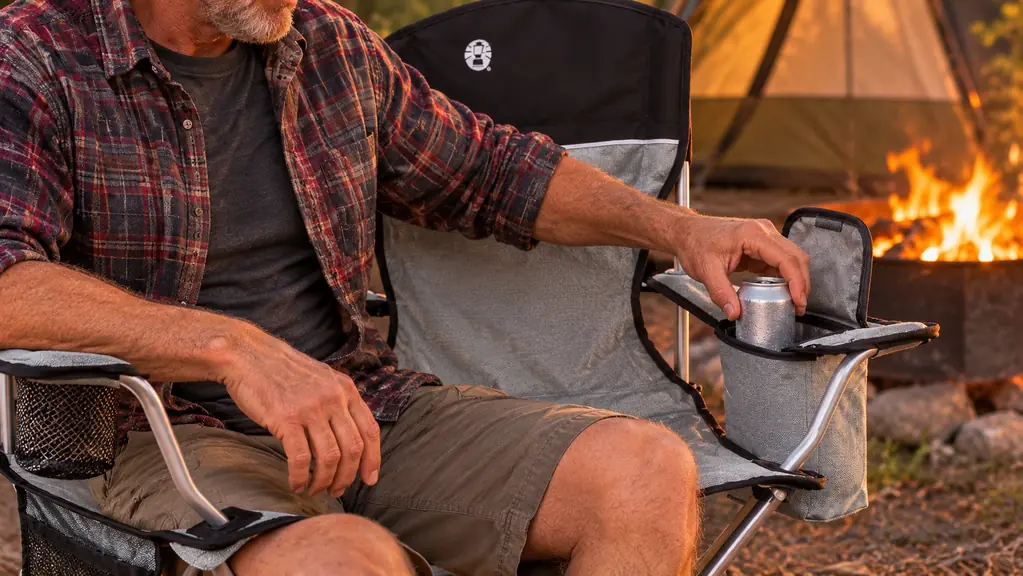
Coleman Portable Camping Chair with a 24 inch seat, a cushioned head rest, and a 4 can cooler built into one arm so you are not walking to the cooler all evening.
Amazon Check Today's Price on Amazon →The Five Steps I Use Before I Buy Any Camp Chair
Step 1: Measure the Seat Before You Look at Anything Else
Seat width is the first number because it decides whether you fit or merely perch. A narrow seat pushes your hips together and your knees inward, and twenty minutes of that is worse than a hard bench. Look for a seat that is 22 inches wide at minimum for an average adult, and wider if you are broad through the hips or you like to sit with a leg tucked up under you. The Coleman chair lists a 24 inch seat, and that extra couple of inches is the difference between sitting and balancing. It is also the reason two people of very different sizes can use the same chair without either one complaining.
Seat depth matters just as much and gets discussed a lot less. Too shallow and the front edge digs into the back of your thighs. Too deep and the back of the seat pushes your knees up while the front edge cuts off circulation behind your knee. You want roughly two fingers of clearance behind your knee when your back is against the backrest. Arms help here more than people expect, because you can push down on them to stand instead of rocking forward like a turtle on its back. Both of my current chairs have arms. I will not buy one without them again.
One more thing in this step, and it is the part people skip. Sit in the chair for a full half hour before you decide, not thirty seconds. A concrete floor in a store will tell you more than any listing photo ever will. If you are ordering online, set it up in the driveway the day it arrives, bring out a book, and time yourself. If you are squirming at thirty minutes, you will be miserable at three hours. That test has saved me more money than any review I have ever read, including this one.
Step 2: Check What Your Back and Neck Are Resting Against
Most camping chairs stop at your shoulder blades. That works fine if you sit perfectly upright all evening, and nobody sits perfectly upright all evening. Once the fire settles down and the conversation goes quiet, you lean back. If there is nothing behind your neck, your head drops forward and you wake up at eleven with a stiff neck and no memory of the last hour. I have done that in a cheap chair more times than I care to admit.
The Coleman has a solid back panel rather than a sling of straps, plus a cushioned head rest across the top. The solid back matters over time, because a strap back stretches out across a season or two and starts to sag into a hammock shape that is comfortable for about ten minutes and then is not. The head rest matters because it catches your neck at the exact point where you would otherwise fold forward. In the listing photos it looks like a small detail. It is not a small thing at ten at night in October.
Test the back by leaning into it hard before you commit to anything. Push your shoulders back the way you would settling in for a long movie. If the frame creaks, or the fabric gives more than a couple of inches, that give will turn into permanent sag by August. A chair that feels slightly firm in the store is usually the one that still feels fine in year three. Soft and cushy at the start usually means flat by the second season.
Step 3: Decide What You Want Within Arm's Reach
Here is the real reason camp chairs get uncomfortable. It is not the cushion. It is the getting up. If your drink is on the ground, you are bending over every twenty minutes and your back pays for it. If your phone, your reading glasses, the dog's leash and your headlamp are scattered across a picnic table six feet away, you are up and down all evening. Everything within reach is a comfort feature, and most chairs treat it as an afterthought.
The Coleman puts a four can cooler into one armrest and a mesh cup holder into the other, plus side pockets for the small stuff. The cooler is the feature people ask about, and it earns the attention. Four cans plus ice in a soft sided compartment means you are not walking to the big cooler every time you want a refill. In practice I use one side for drinks and the other for the leash, the headlamp and a folded bandana, and I can reach all of it without moving my back off the panel.
Whatever chair you end up with, check that the cup holder is deep enough that a tall tumbler does not tip out when you stand up. Shallow cup holders on a folding frame are a bad combination, and I have lost a full mug of coffee to one. The mesh holder on this chair has held everything from a can to a travel mug, and nothing has gone over the side yet.
Step 4: Take the Weight Rating Seriously, Then Add Real Life
A weight rating is not a suggestion, and it is not only about the person sitting down. Think about what actually happens in camp. Biscuit leans against the front of the chair when he thinks I am about to leave. A grandkid climbs into a lap. Somebody sets a loaded cooler bag on the armrest because there is nowhere else to put it. A chair rated at 250 pounds that spends a weekend doing all of that will start loosening at the joints by the end of the season.
The Coleman is rated to support up to 325 pounds, and that is the number that made me look twice at a folding chair. That margin is why the frame still feels tight in the fourth season. I am not a small woman, and I have never once felt this chair flex in a way that worried me. If you are buying one chair for two people of different sizes, buy the higher rated one. It costs you a few seconds of setup and nothing else.
Look at what the rating is attached to, too. A big number on a chair with skinny legs and plastic joints does not mean much. You want the load spread across a wide base and real metal where the legs cross. Set the chair on flat ground, sit down squarely, and rock gently side to side. Any wobble that shows up on a store floor gets worse on a gravel pad, and gravel pads are where you will actually be sitting.
Step 5: Fold It, Carry It, and Load It Before You Decide
Comfort is not only the seat. It is also the four minutes of your evening you spend wrestling a chair out of its bag in the dark. A chair that fights you on setup gets left in the SUV, and then you are sitting on a cooler for the weekend pretending that is fine. I understand the impulse completely, because I have done it.
The Coleman sets up the way a folding quad chair should. Pull the frame apart, press the back down, and you are finished. It is listed at 3.5 kg, so a bit under eight pounds, and the open dimensions are 40.5 inches deep, 24 inches wide and 37 inches high. Folded, it slides behind the passenger seat of my Forester with room left over, which matters when the back is already full of dog gear and a food cooler. Check the folded length against your own vehicle before you buy anything, especially if you drive a sedan or a small crossover with the seats up.
Then do a dry run at home. Set it up, sit in it, fold it, put it back in the car. If any part of that sequence annoys you in your own driveway in daylight, that annoyance doubles at dusk with a dog pulling at the leash. The chair I keep is the one that disappears into the routine. That is the whole test, and it beats every spec sheet ever printed.
The number that changed my mind was 325 pounds. Not because I weigh that. Because in four seasons this chair has never once felt like it was working hard.
What Else Helps
A mat under the chair. A cheap piece of indoor outdoor carpet or a rubber mat keeps the legs out of the mud and stops the chair from sinking into soft ground after a rain. It also gives Biscuit somewhere dry to lie down that is not my lap. I keep a three by five mat rolled up behind the driver's seat, and it takes ten seconds to throw down.
A blanket within reach after sunset. Tennessee evenings go cold fast once the fire dies down, and a dog that runs hot all day can be shivering by nine. I keep a fleece over the armrest, not in the tent, so I can toss it over him without standing up. A chair with a cooler in one arm and a blanket over the other is a chair doing real work.
Light, and something to set a plate on. A headlamp around your neck beats a lantern on the table because the light goes where you look. A small folding side table gets dinner off your knees, which matters when the dog has decided your lap is the best seat in camp. None of this is expensive and all of it makes the chair feel better than it is.

Where People Go Wrong
Buying on the folded size and forgetting the open size. A chair that packs down small but sits low to the ground is fine for a fishing trip and miserable for a long evening, because you have to lever yourself up out of it every time you want to move. The Coleman sits at normal chair height with a 37 inch back, so I stand up out of it the same way I stand up out of a kitchen chair.
The other mistake is buying for the best case. You will not be sitting in this chair for twenty minutes on a sunny Saturday afternoon. You will be sitting in it for four hours in the dark, in a jacket, with a dog leaning on your leg and a drink you would like to reach without standing up. Buy for that evening. The photo will take care of itself.
Four seasons in, the cooler arm is the reason I stopped shopping
Coleman Portable Camping Chair: 24 inch seat, solid back with a cushioned head rest, a 4 can cooler in one arm, a mesh cup holder in the other, rated to support 325 pounds.
Amazon Check Today's Price on Amazon →