
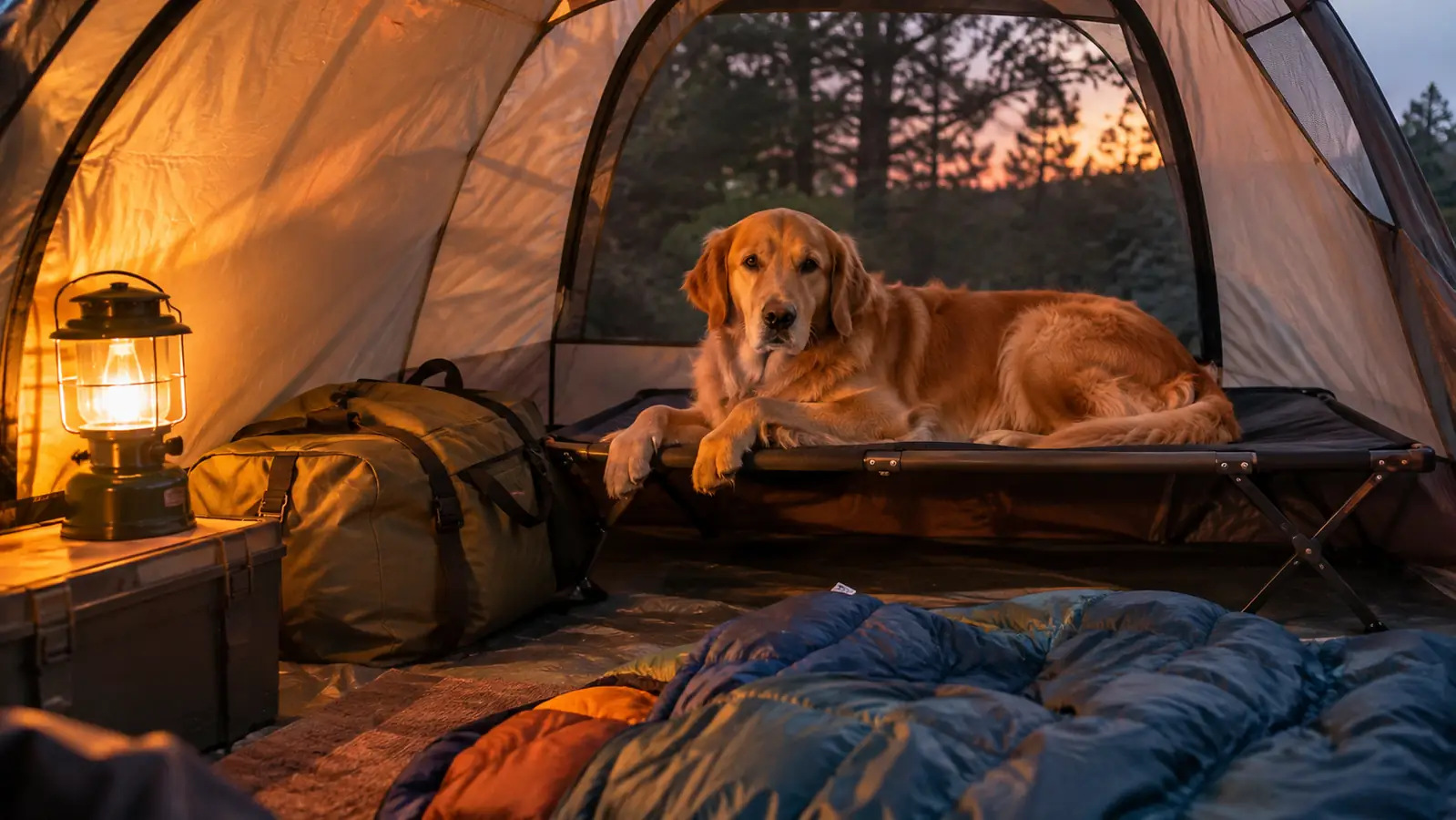
Biscuit does not sleep well on a tent floor. She shifts. She digs at the nylon. She presses her back into my sleeping bag like she is trying to get away from something underneath her, and then she does it again twenty minutes later. For two seasons I assumed that was just how a dog sleeps in a tent, and I put up with it, and so did she. Then I set an elevated cot up inside the tent for one weekend in the Cherokee National Forest and she slept straight through until the birds started. The cot was the fix. Everything since has been small adjustments around it, and the whole routine now costs me about fifteen minutes at the front end of a trip.
The cot I use is the Veehoo Outdoor Elevated Dog Bed in the 42 by 30 inch size, and it rides behind the passenger seat of my Forester all season. It weighs a little over six pounds and it goes together without tools, which sounds like a small thing until you are standing in the dark with a flashlight in your teeth. But the bed is only half the job. The other half is where you put it, what goes around it, and what you do in the hour before you zip the door shut. Get those wrong and a good bed still gives you a bad night.
One less thing shifting around at two in the morning
The Veehoo elevated cot is 42 by 30 inches, lifts your dog 7 inches off the tent floor, and sets up without tools. It is the piece everything else in this routine gets built around.
Amazon Check Today's Price on Amazon →Step 1: Measure Your Tent Floor Before You Buy Anything
Pitch the tent in the yard and measure the usable floor with a tape, in inches. Not the listed floor dimensions, which count corners you cannot put a dog in, but the flat clear rectangle that is actually left after your pad and your bag. My three-person dome lists a floor that sounds generous, and then the sloped walls eat six inches on either side. The Veehoo takes 42 by 30. With my pad down there is still a clear strip to walk in without stepping on the mesh. If I were in a two-person tent, I would lay it all out on the grass before I committed to the trip, because that is the tent where this gets tight.
Height matters as much as footprint. The cot puts the sleeping surface 7 inches off the floor, and that gap is the entire point of it. It is also the thing that goes wrong in a low tent. If the wall slopes inward where the cot sits, the dog ends up leaning against the fabric all night, and fabric is where the condensation collects. Set the cot where the wall runs straight up. If there is no such spot, know going in that you will be wiping the inside of the tent in the morning.
And measure the dog, not the label on the box. Biscuit is 45 pounds and change, and the 42 by 30 surface gives her room to stretch out and turn around without hanging a leg off the edge. A dog much past 70 pounds is going to want more real estate than this. Measure nose to tail while your dog is stretched out asleep, because that is the number that matters. The number where they are standing up and trying to look small is not the number.
Step 2: Set It Up at Home Before It Ever Sees a Tent
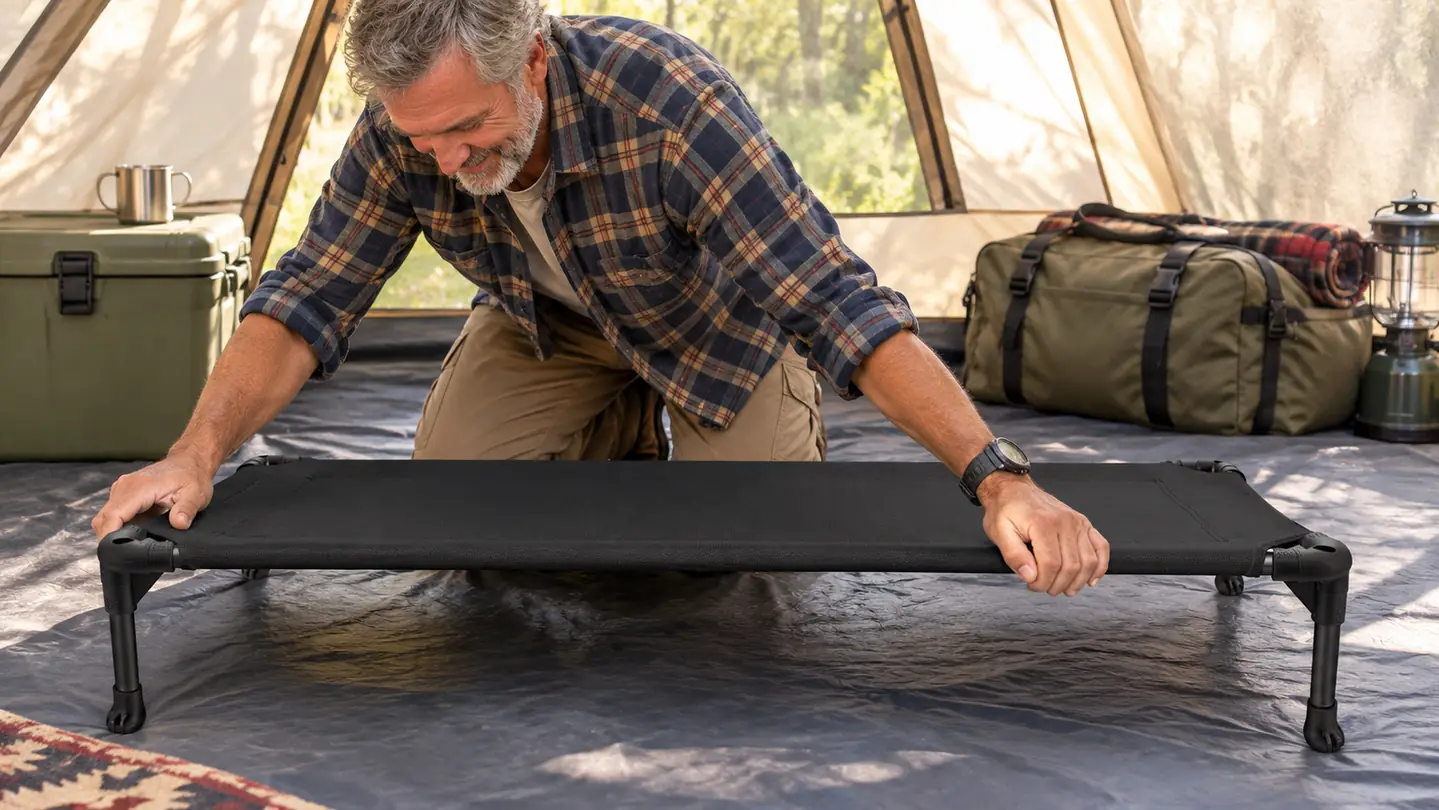
The frame goes together without tools, but it does not go together instantly the first time, because you have to work out which end of the mesh goes where. Do that in your living room on a Tuesday, not at a campsite at dusk with a storm coming over the ridge. I set mine up in the yard, put a worn fleece on it, and left it out for a week. Biscuit ignored it for two days, napped on it in the afternoons by day four, and by the weekend it was hers and nobody else's.
The other reason to set it up early is to check the feet against the floor of your tent. The cot has a non-skid bottom and non-slip feet, and on a patio or a wood deck that grip is serious. Tent floors are slick nylon, and slick nylon is a different problem entirely. If the floor is damp, which in my tent it usually is by morning, the feet can walk a little when a dog hops on. A scrap of thin closed-cell foam under each end solves it and weighs close to nothing in the pack.
Feed your dog a meal on the cot at home. Put a chew on it. Sit down next to it with a book for twenty minutes. The point is to build the association before the night you actually need it, so that on the trip the cot is familiar furniture instead of a strange object in a strange place on the one evening everyone is already tired.
Step 3: Build the Sleep Zone Before You Unroll Your Bag
Orient the cot across the back of the tent, not along a side wall. That keeps the dog out of the condensation line and out of the door zone, which is where the cold air and the wet paws come in. In my tent the door sits on the short end, so the cot goes crosswise at the far end, my pad goes in the middle, and the duffel goes at my feet. That layout has not changed in three seasons and I do not expect it to.
Whatever goes on the floor under the cot, keep it thin. The whole function of the bed is air moving under it, up through the mesh, around the dog. A thick rug underneath cancels the cooling and holds the damp. I use a thin closed-cell pad cut to the footprint, mostly to protect the tent floor from the feet and to stop the whole thing from sliding when she jumps up.
Then put a small mat or a folded towel just off the cot, near the door. That is where the wet paws land when the dog comes in, and it keeps the mesh from becoming the towel. The mesh is easy to clean and it hoses off in about a minute, but you do not want to be scrubbing it at ten at night with a headlamp in your mouth while the dog waits.
The cot puts her seven inches off the tent floor, and that seven inches is the difference between a dog that sleeps and a dog that paces.
Step 4: Plan for the Temperature Swing, Because There Will Be One
Biscuit runs warm. On a July afternoon she will lie on the mesh and let the air move under her and she is perfectly content. Then the sun drops, the temperature falls fifteen degrees in about an hour, and she gets restless and cold and starts pressing against my bag again. That swing is the part nobody warns you about, and it is the part that decides whether the night works. A bed that is perfect at four in the afternoon can be the wrong bed by ten.
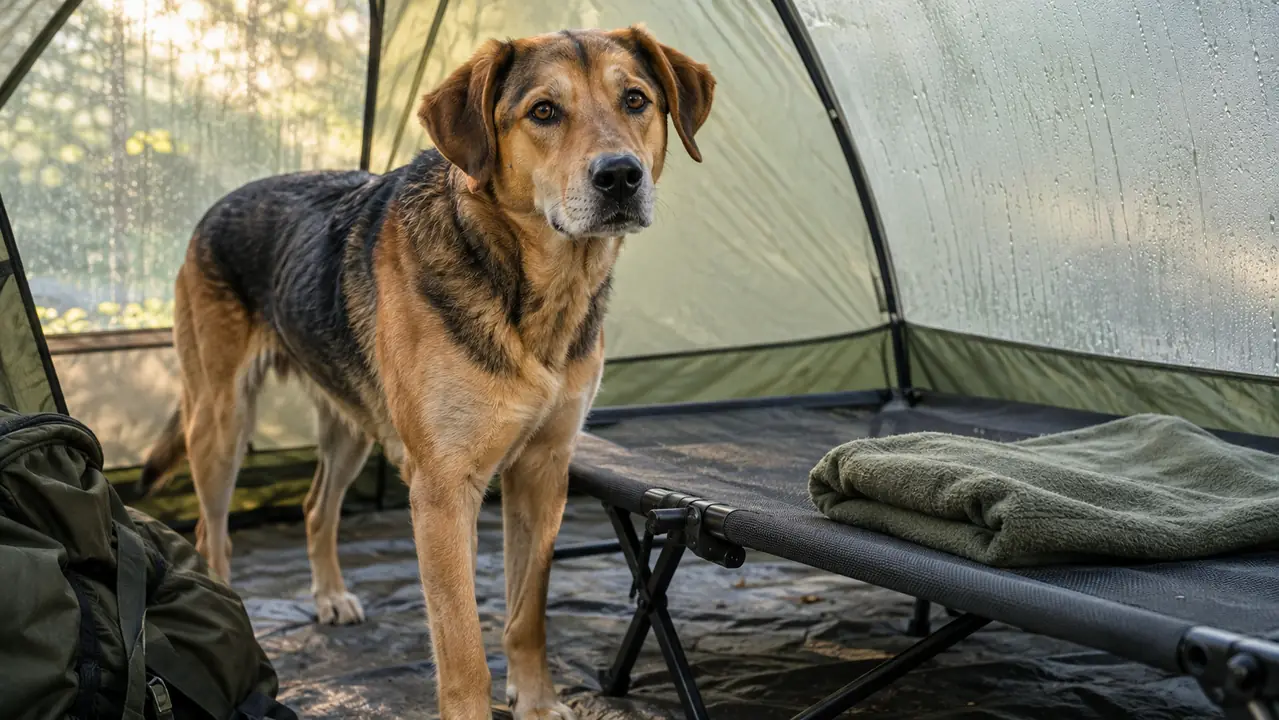
So the bed gets dressed twice. Through the day and into the evening it stays bare mesh, which is the cooling part, and it keeps her off the damp ground. Somewhere around dark I lay a thin fleece over the mesh, just a camp blanket folded once, and she settles onto that. If it is going to be genuinely cold I add a second layer. If she starts panting I take one off. It sounds fussy. It takes ten seconds, and it is the difference between a dog that sleeps and a dog that paces until the sky turns gray.
Keep the cot out of the draft line and away from the direct path of the door vent. Air movement underneath is good. Air movement across a cold dog at three in the morning is not. I crack the vent on the opposite side of the tent from the cot and leave it at that. It is enough to keep the walls from raining on us and not enough to chill her.
Step 5: Run the Last Hour the Same Way Every Night
The last hour before I zip up looks the same on every trip, and the sameness is most of the value. The water bowl gets picked up about an hour before lights out. Biscuit gets a walk to the bathhouse and back, on leash, even when she does not seem to need it. Paws get wiped. Belly gets checked for burrs and ticks. She gets brushed off with a hand before she is allowed up on the cot, because a dog carrying half the forest floor into bed is a dog who wakes up at midnight.
Then she goes up on the cot with something to chew, I zip the door, and I turn the lantern down low. She settles in about five minutes. The chew is not really a treat, it is a signal. After a few trips, a chew on the cot means the day is over and the night is starting, and she reads it exactly that way.
One more thing, and it is the least glamorous item in the whole routine. I keep a small towel and a headlamp in the same pocket of the tent every single night, so that when something goes wrong at two in the morning I am not searching for it in the dark. Something always goes wrong at two in the morning. Usually it is a raccoon. Occasionally it is the dog deciding she needs to go back out. Being able to find the towel without waking the whole loop is worth more than any piece of gear I have bought in five years.
What Else Helps
A small battery-powered fan clipped high in the tent is the best addition to this setup in hot weather. It moves air across the mesh, and moving air does more for a dog's comfort on a warm night than any blanket will. I run mine on low overnight and it lasts a whole weekend. Just keep it pointed across the tent, not straight down at the dog, or you are back to the cold draft problem you just solved.
A short leash and a stake-out point outside the door give you somewhere to put the dog while you set the cot up, and they keep you from doing the entire job one-handed. A cheap indoor-outdoor thermometer hanging from a tent loop tells you what the dog is actually experiencing at two in the morning, which is routinely four or five degrees colder than you assumed when you went to bed. I stopped guessing about the second layer once I started reading that thing.
Last, learn the cleaning routine before you need it. The Veehoo mesh wipes down and hoses off, and it dries fast in the sun, so a muddy morning does not cost you the rest of the trip. I wipe the frame joints with a rag at the end of each weekend and check the mesh corners for fraying. Three seasons of weekends later it is still doing the job. That is not a laboratory durability test. It is three seasons of real use in Tennessee and western North Carolina, and it is the only test I trust.
Fifteen minutes of setup, then a dog that sleeps through
The Veehoo elevated cot is 42 by 30 inches, weighs about six and a half pounds, sets up without tools, and gets your dog up off the cold, damp tent floor. Everything in this routine is built around it.
Amazon Check Today's Price on Amazon →