
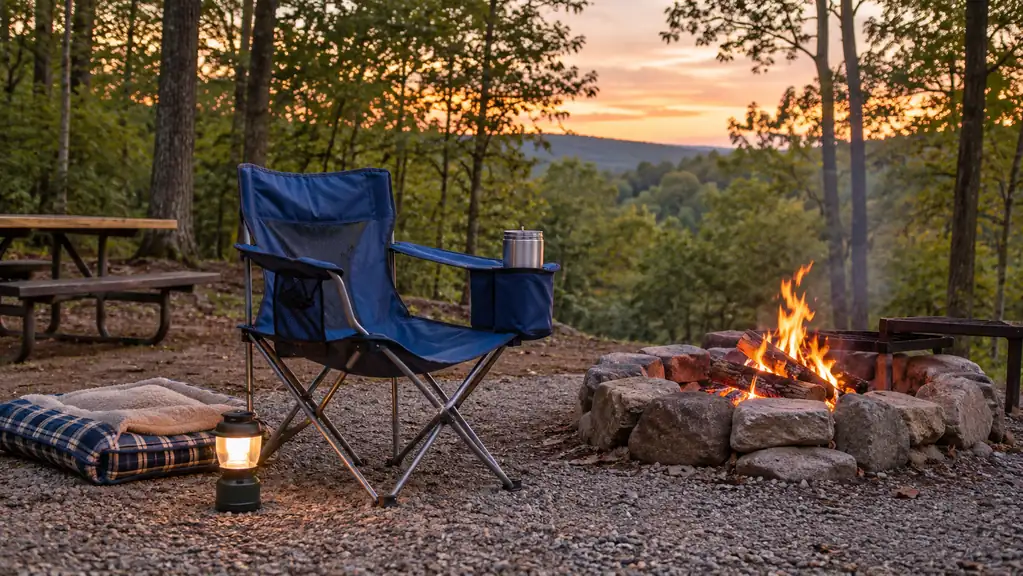
Nobody warns you that a camping chair ends up being the piece of gear you judge a whole trip by. Not the tent. Not the stove. The chair. Somewhere on the second evening, when the light goes flat and the fire is finally burning right, whatever you are sitting in decides whether you stay out another hour or give up and turn in at eight-thirty. I camp most weekends from spring through late fall, car camping out of a 2017 Subaru Forester, mostly Tennessee state parks and a handful of national forest campgrounds in western North Carolina. My dog Biscuit comes with me. He is a six-year-old Australian Shepherd mix, about forty-five pounds, and he runs warm until the sun drops, and then he wants to be touching somebody. The Coleman chair with the four-can cooler built into the arm got picked for one reason. I was tired of balancing a cup on my knee while Biscuit circled the fire ring looking for a place to settle.
This is the review I wish somebody had handed me in the aisle. Not the spec sheet version, the lived version. The cooler arm takes four cans and no more. The whole chair weighs about 7.7 pounds, which you feel on the second walk to the bathhouse. And Coleman lists no manufacturer warranty on it at all, which is worth knowing before you assume otherwise. Two seasons in, it still rides in the back of the Forester every single trip. But several things about it matter more than the photos let on, and one of them nearly sent me looking at a different chair.
The Quick Verdict
A steady, roomy chair with a cooler arm that genuinely earns its place at a two-person campfire. Held back by its weight, a cooler that holds exactly four cans and sweats through a bandana, and no manufacturer warranty.
Amazon Check Today's Price →Two Seasons In, It Still Rides in the Back of the Forester
Four cans in the arm, a 24-inch seat, and a 325-pound rating. Here is the current price and every detail on the listing, including the warranty line.
Amazon Check Today's Price on Amazon →How I've Used It
Call it thirty-five or forty nights out across two seasons. Weekend trips, two or three nights each, spring through late fall. I set up at a couple of the state parks near Chattanooga, at a TVA campground on the water, and on three separate trips up into the Nantahala. My routine does not change. The chair comes out of the back of the Forester first, because Biscuit will not settle until I sit down. That sounds like a joke. It is not. He circles until I am in a chair and then he lies down against my leg. So the chair is less furniture than it is the thing that starts camp.
I have used it for coffee at 6:40 in the morning in forty-degree air, for reading in the afternoon shade while Ray fished, and for the long stretch after supper when the two of us sit up and argue about whether it is worth putting another log on. It has held a paper plate on my knee, a lantern on the ground beside it, and a leash looped over the arm. Which is the real test of a camp chair. Not whether it survives being sat in, but whether it can be the desk, the kitchen table and the dog bed all at once.
The first trip with it was the second weekend of April, at a state park outside Dayton, Tennessee, and it rained both nights. I set the chair up under the awning of the Forester, which meant I sat in it with my knees about six inches from the back tire and my coffee getting rained on anyway. Biscuit spent that trip jammed between my leg and the door panel. What I learned that weekend is that the footprint is what makes the chair work in a tight spot. The four legs sit wide and flat, so on a packed gravel pad it does not wobble even when the ground under one corner is a little lower than the rest. The little folding chair I had before that had three legs and a prayer. This one has four and it stays put.
The Cooler Arm Is Smaller Than You Picture
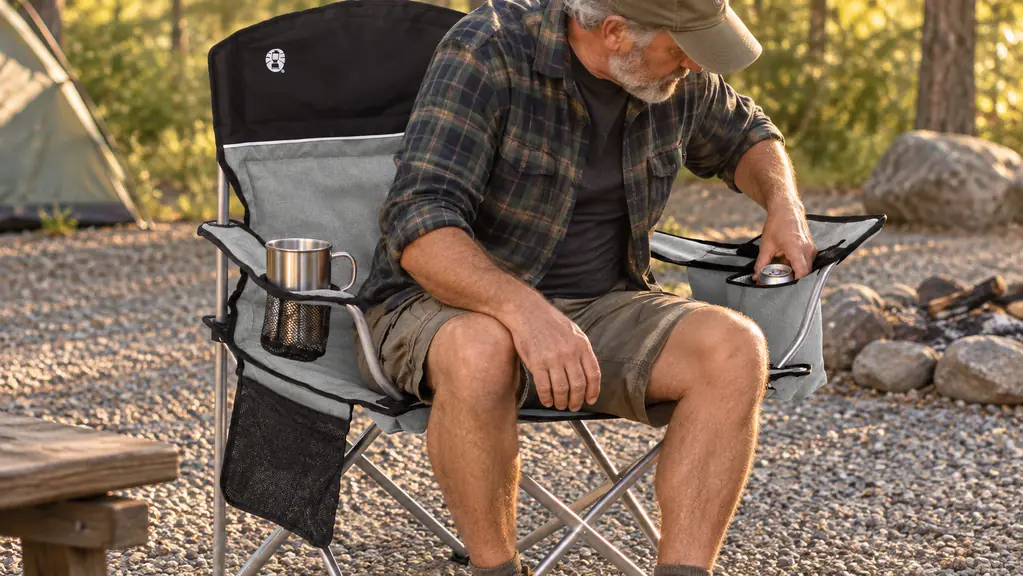
Here is the part nobody tells you. Four cans is four cans. The compartment in the arm is built to hold a four-pack and it holds exactly that, with maybe a finger of room left over. Drop a handful of ice in first and you are down to three cans and a wet hand. On a ninety-degree July weekend in Tennessee, that ice is water in about an hour and a half. I started bringing a bandana to lay over the lid, because the outside of the compartment sweats right through onto the cushion. That is not a defect. It is physics and a plastic box.
What it is genuinely good at is the exact thing I needed. A cold drink within reach without standing up. Getting up means stepping over a dog, and stepping over a dog at night means finding the one rock in the whole campsite with your bare foot. The arm cooler solves that. The mesh cup holder on the other arm takes a cup with a handle, a bottle, or my phone when I set it down. The side pockets hold keys, a headlamp and the leash. None of it is fancy. All of it gets used every trip, which is more than I can say for half the gear I own.
Before this chair I tried two other things, and both of them failed for reasons I should have seen coming. The first was a soft-sided six-pack cooler I set on the ground between the chairs. It worked fine until Biscuit decided the space between the chairs was his, and then it worked fine as a dog pillow. The second was one of those cup holders that clamps onto a chair arm. It held one cup, it tipped every time I leaned on that arm, and the clamp snapped on the third trip. What the built-in compartment does better than either is that it is part of the chair. There is nothing to knock over and nothing extra to pack. I open the lid, take out a can, close the lid.
The cooler arm holds four cans and sweats through a bandana every July. I have not had to step over a sleeping dog for a cold drink in two seasons of camping.
The 24-Inch Seat and What It Means With a Dog
The seat is 24 inches across, the chair stands 37 inches tall, and the listing gives 40.5 inches front to back. What that means in practice is that there is room for me and about half a Biscuit. He is forty-five pounds and he is not invited up, but on the cold nights he puts his front paws on the edge and leans, and the chair does not tip. That is the part I did not expect. A wider footprint plus a solid back makes it steadier than the small folding chair I had before, the one I dumped myself out of twice in one weekend.
The cushioning is where it earns its place for me. Cushioned seat and back, plus a cushioned head rest that lands right at the base of my skull when I lean back. At fifty-eight, with a spine that spent thirty years under school buses, that head rest is the difference between staying out for the second hour and going inside to lie down. I did not think I cared about it. I care about it a great deal.
The 325-pound weight rating is worth noting for reasons past the obvious. It means the frame does not flex when you shift your weight, and it means Ray, who is not a small man, can sit in this chair without me watching him out of the corner of my eye. The arms are wide enough to set a mug down on and forget about. That is not on any feature list, but it is why I reach for this chair and not the other one in the shed.
Setting It Up and Taking It Down
It opens in about two seconds. No latch to fight, no pinching bar that catches the web of your hand the way the cheap chairs do. I have set it up in the dark, by headlamp, in the rain, with a dog milling around my ankles, and I have never once had to think about it. That counts for something when you roll into a campground at nine at night after a longer drive than you planned.
Folded, it slides in behind the passenger seat of the Forester and stays there for the season. It is not tiny. The cooler arm adds bulk at the top, so it takes up more room than the bag chairs that fold down to nothing. I have given up about a third of the floor space behind the seat and I have decided that is a fair trade for a chair I can sit in for three hours without my back complaining.
The other thing I do at the end of every trip is wipe the cooler compartment out and leave the lid open to dry overnight. Closing it damp is how you get the smell. It takes thirty seconds and it has kept mine from turning into a science experiment. Folded, the chair goes behind the passenger seat with the legs toward the door, and I lay the dog bowl on top so it does not slide around on turns. That is the whole routine. Thirty seconds open, thirty seconds wipe, and the rest of the trip it is just a chair that works. I have done that routine at least forty times now without thinking about it, which is its own kind of review.
What Two Seasons Did to It
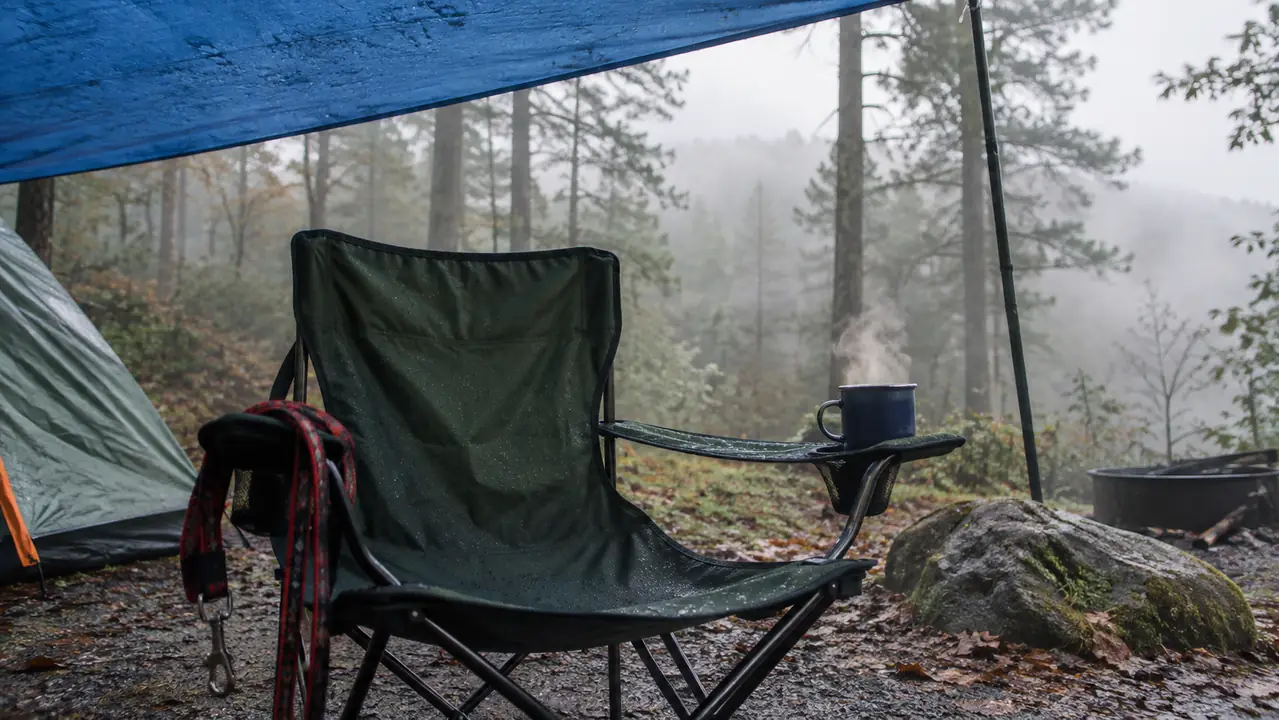
Nothing has broken. No weld, no rivet, no tear at the seam where the fabric meets the frame. The fabric has faded some in the sun, which any outdoor fabric will do, and there is a spot of pine sap on one arm I have given up on. I have not found rust at the joints, and this chair has been left out in the rain more than once because I misjudged a forecast and did not want to wrestle a tarp at midnight.
The compartment lid still closes flush, which surprised me, because it is the piece that gets opened and shut twenty times a weekend. The mesh cup holder has stretched a little, the way mesh does, so a narrow bottle now sits looser than it used to. The side pockets have held up better than I expected, given that I stuff a leash, keys and a folded rain jacket into one of them and then forget it is there for a week.
The one bit of upkeep nobody mentions is that the compartment collects things. Twice now I have opened it on the first trip of the season and found little mud dauber nests built in the corners, the way they get built in any enclosed space that sits in a shed over the winter. Both times a bottle brush and the hose took care of it in a minute. I also learned not to leave a can in there between trips. One sat in the Forester for three weeks in June and the compartment smelled like a bait shop until I scrubbed it with dish soap and left it open in the sun for a day. That is on me, not on Coleman, but it is the kind of thing a review ought to say.
The honest limitation is the ground under it. Coleman lists hard floor as the recommended surface, and after two seasons I understand exactly why. On packed gravel and hard dirt the chair is rock solid. On soft wet grass, or in the sand at a lakeside site, the legs sink and you end up sitting tilted forward like you are about to say something important. I carry two flattened cans to put under the front legs when I know I am on soft ground. Not elegant. It works.
What I Liked
- Wide 24-inch seat with a 37-inch back, roomy enough that a 45-pound dog can lean on the edge without tipping it
- Cushioned seat, back and head rest that hold up for a three-hour sit
- Cooler compartment in the arm keeps four cans within reach without standing up
- Mesh cup holder and side pockets that actually get used for keys, headlamp and leash
- Rated to 325 pounds and the frame does not flex under a heavier sitter
- Two seasons of weekend use with no tears, broken rivets or rust at the joints
Where It Falls Short
- About 7.7 pounds, which you notice on a long walk to the bathhouse
- The cooler holds exactly four cans, and ice takes one of those slots
- The compartment sweats through onto the cushion in July heat
- No manufacturer warranty listed
- Legs sink into soft grass, sand or wet ground, so you need to shim them
- Bulkier than a bag chair when folded
The Parts I Don't Love
Weight. Seven and a half pounds does not sound like anything until you are carrying it, a lantern and a dog bowl a quarter mile to the bathhouse at eleven at night. I am not a small person and I am not weak, and I still notice it. If your campsite is a long walk from where you park, or if you are carrying gear for two, this is not the chair to pick.
The warranty line is the other one. There is no manufacturer warranty listed on this chair. I am hard on gear and I like knowing somebody stands behind it. Coleman is a big outfit and this chair is built like it will outlast the one I had before it, but the paperwork is honest about that gap, and I would rather know it going in than find out after.
Who This Is For
You drive to your site. You sit for two or three hours at a stretch, in the evening and again in the morning. You camp with a dog who wants to be against your leg, and you have learned that getting up twenty times for a drink is its own kind of tired. You are past fifty and your back has opinions. You want a chair that stays put on a gravel pad and holds a cup where you can reach it. That is exactly the person this Coleman chair was built for, and it is why mine goes in the car first every trip.
Who Should Skip It
Backpackers and anyone with a long walk-in should skip it outright. So should anyone who wants a rocker or a recliner, because this does one thing and it does it sitting upright. If a warranty matters to you, buy something else, because there is not one here. And if you plan to keep a six-pack cold for four hours, bring an actual cooler, because this arm holds four cans and it sweats. For the rest of you, sitting on a gravel pad with a dog against your leg and a cold drink at your elbow, it is a straightforward yes.
If You're Going to Sit in It for Three Hours, Get the One With the Cooler
The 24-inch seat, the cushioned head rest, the four cans in the arm. Check the current price and the full listing details before your next trip.
Amazon Check Today's Price on Amazon →