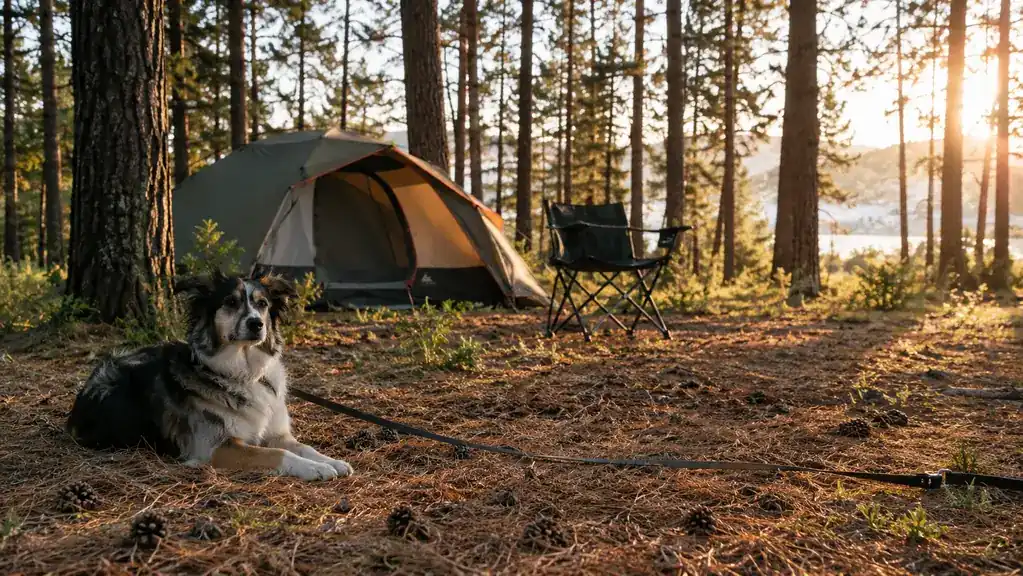
The first time Tucker wandered at camp, I was rinsing coffee cups and didn't notice him leave. He was gone maybe four minutes before I heard a woman two sites over say, "Whose dog is this?" He had followed a scent trail straight to their cooler. Nobody was mad. But it taught me the rule I now repeat to every camper I meet: if your dog can wander, your dog will wander. A tie-out cable fixes that in about five minutes, and it fixes it every single night for the rest of the trip.
I'm Rick Dawson. I'm 58, I camp most months of the year in state parks and national forest campgrounds within a day's drive of the upstate of South Carolina, and I bring my hound mix Tucker, who is six years old, about 55 pounds, and blessed with a nose that can find trouble from a hundred yards away. This guide is the exact routine I use to keep him on the site, out of the fire ring, and away from the road. The BV tie-out cable is the piece of gear I trust for it, and I'll show you how to set it up so it stays tangle-free all weekend.
The cable that keeps Tucker on the site all weekend
The BV Dog Tie Out Cable gives you 25 feet of reflective, rust-free line with swivel clips on both ends and a 360 degree rotating clasp. It handles dogs up to 90 pounds, which covers everything from a 12-pound terrier to a big retriever. I have used mine for two seasons of camping and it still looks like the day I bought it.
Amazon Check Today's Price on Amazon →Step 1: Pick the right anchor, not just any stake
The anchor is the whole ballgame. A flimsy stake that wiggles in loose soil will pull out the first time your dog lunges after a squirrel, and then the tie-out is just a long leash dragging behind a very free dog. I use a corkscrew-style ground anchor rated for the dog's weight, and I drive it in at a slight angle, leaning away from the center of the site. That angle gives the anchor a lot more holding power than a straight-down stake.
Pick a spot with firm soil, not sand and not a patch of soft duff. Avoid the middle of the path where people walk, and keep the anchor at least ten feet from the fire ring and the road. The BV cable comes with a sturdy stake that works fine for most campground soil, but if you camp on sandy ground the way I do at some national forest spots, I carry a heavier corkscrew anchor as a backup. The cable itself is the same either way; the anchor is what changes.
One more thing: check the anchor every morning. Campground soil shifts, rain softens it, and a stake that was solid on Friday can be loose by Sunday. I give mine a twist first thing with the coffee, and it takes about four seconds.
When the ground will not hold a stake at all, use what the campground gives you. A tree with a trunk at least as thick as your forearm makes a solid anchor; loop the cable around it near the base so a pulling dog cannot work it up the trunk. The picnic table works in a pinch on level sites, but only the heavy concrete or bolted-down kind, never a light aluminum table a determined dog can drag.
Step 2: Set the cable length so the dog has room but not the whole site
The BV tie-out gives you 25 feet of cable, and here is the mistake almost everyone makes: they let the dog have all 25 feet. That puts the dog in the fire ring, in the neighbor's site, and right at the edge of the road. The point of a tie-out is not maximum range. It is a safe range.
I wrap the excess cable around the anchor stake once or twice to shorten the working length to about 12 to 15 feet. That gives Tucker room to stretch out, turn around, and sniff the perimeter of our site without reaching the fire, the cooler, or the truck tires. If we are at a site with a lot of foot traffic, I shorten it even more. You can always let out more cable; you cannot un-smell a skunk.
The 360 degree rotating clasp on the BV cable is what keeps the line from twisting into a knot as the dog circles. I have used cheaper cables that turned into a braided mess by the second day. This one stays straight because the clasp turns with the dog instead of fighting him.
Step 3: Clip to a collar or harness that cannot slip off
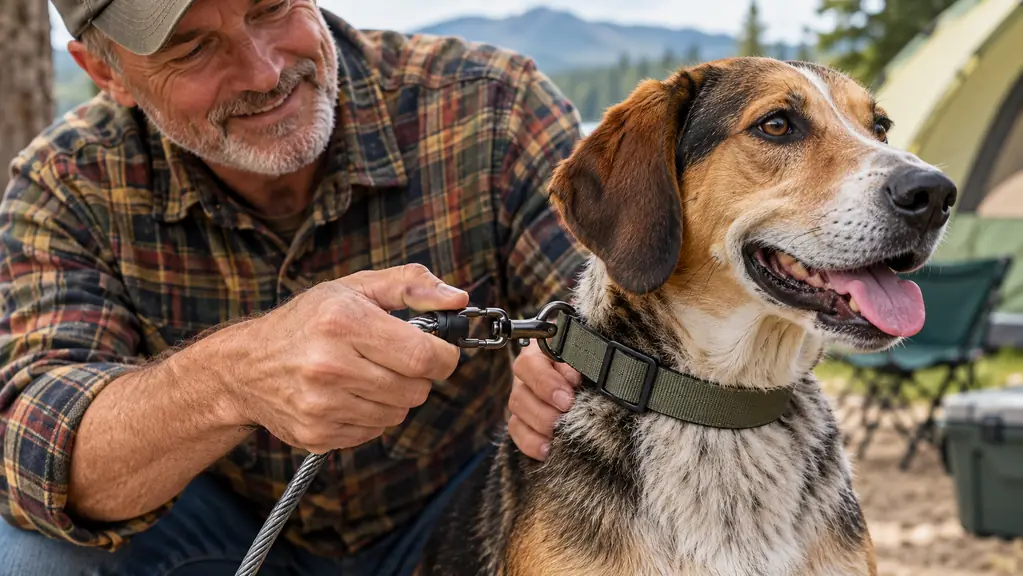
A tie-out is only as good as the collar it clips to. A loose flat collar can slip right over a dog's head when he pulls, and then you have a dog wearing a tie-out that is attached to nothing. I use a snug flat collar that I can just barely fit two fingers under, and I clip the BV cable's swivel clip to the metal D-ring, not to the buckle and not to the collar fabric.
If your dog is a puller, a harness is the safer choice. The BV cable clips to the harness's rear ring the same way, and a harness spreads the pressure across the chest instead of the neck. Tucker wears a collar for hanging around camp and a harness for anything more active. Both work with the cable's quick-release clips, which is one of the reasons I picked this one.
Before you clip, check the collar for wear. A collar that is cracked or frayed can fail at the worst moment, usually when the dog is at the end of the line after a rabbit. I replace Tucker's collar once a year whether it looks worn or not. It is cheap insurance.
Fit matters as much as condition. With a flat collar, you should be able to slide two fingers under it and no more. Too loose and a dog who backs up hard can pull out of it. A harness should be snug enough that it does not twist sideways when the dog pulls at an angle, which is exactly how a dog on a tie-out pulls. Check both after a swim or a rain, because wet webbing stretches.
Step 4: Keep the cable off the ground and out of the tangle zone
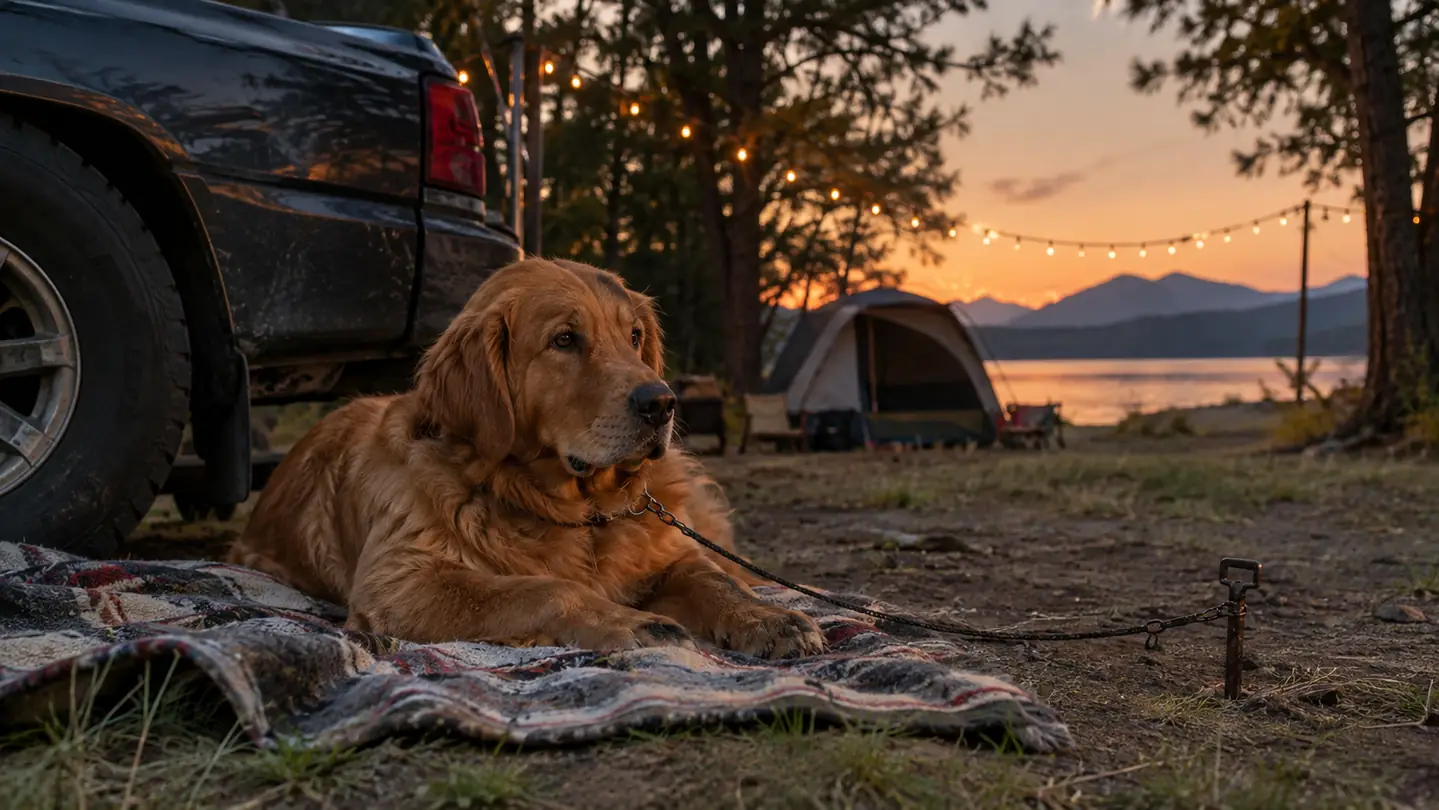
A cable that drags on the ground picks up leaves, pine needles, and mud, and it gives the dog something to step over and get twisted in. I run the BV cable high enough that it clears the ground by a few inches at the lowest point. That means attaching it to the collar at chest height rather than letting it droop, and keeping the anchor close enough to the dog's resting spot that the line stays mostly elevated.
The reflective coating on the BV cable earns its keep at night. When Tucker moves around after dark, the line catches the light from the campfire and the truck, so neither of us trips over it. I also hang a small glow stick on the cable near the anchor when we are at a busy campground. It is a two-dollar trick that saves a lot of stubbed toes.
Check the line for snags before you settle in for the evening. A branch, a tent stake, or a camp chair leg can turn a clean radius into a trap. I do a quick walk of the circle, clear anything the cable could catch on, and then I can sit down and not think about it again until morning.
Step 5: Supervise the first hour, then trust the setup
The first hour on a new tie-out is when dogs test it. Tucker circles, pulls, and tries to figure out if the cable is really as long as it feels. I stay close for that first hour, watch how he moves, and adjust the length if he is reaching something he should not. After that, he settles down and the tie-out does its job while I do mine.
Never leave a dog on a tie-out unattended for hours on end, and never tie a dog out in extreme heat or cold. The tie-out is a tool for camp life, not a substitute for watching your dog. I use it when I am at the site cooking, reading, or splitting firewood, and I bring Tucker inside the tent or the truck when I leave the site or when the weather turns.
The BV cable's quick-release swivel clips make it easy to unhook Tucker the moment I need him, whether that is for a walk, a ride into town, or a sudden thunderstorm. That ease matters more than people think. A tie-out you can attach and release in one hand is a tie-out you will actually use every day of the trip.
What Else Helps
A tie-out cable handles the wandering, but a few extras make the whole camp setup easier. I carry a lightweight camp blanket and lay it near the anchor so Tucker has a clean, dry spot to lie on. I keep a collapsible water bowl within the cable's reach, and I refill it every time I refill my own cup. And I bring a spare carabiner in case I need to attach the cable to a tree instead of the stake, which is handy at sites where the ground is too hard to drive an anchor into.
Shade and water come first. Set the tie-out so the dog can reach a shady spot during the hottest part of the day, and put the water bowl inside the circle where the cable cannot knock it over. A dog bed or blanket inside the circle gives the dog a place to settle, which cuts down on pacing. And keep the fire ring, the cooking area and any tent stakes or guy lines well outside the circle the cable can reach. A dog who gets tangled in a guy line can bring the whole tent down.
The BV tie-out cable is the piece I reach for first, and it has held up through two seasons of camping, rain, mud, and one very determined hound. If you want the same setup without the guesswork, the link below takes you to the current price on Amazon. It is a small piece of gear that makes the whole trip calmer, for you and for the dog.
If your dog can wander, your dog will wander. A tie-out cable fixes that in about five minutes, and it fixes it every single night for the rest of the trip.
Set up camp once, relax the whole trip
The BV Dog Tie Out Cable is the same one I have used for two seasons with Tucker. Reflective, rust-free, and tangle-free thanks to the 360 degree rotating clasp. Check the current price on Amazon and see if it fits your campsite setup.
Amazon Check Today's Price on Amazon →