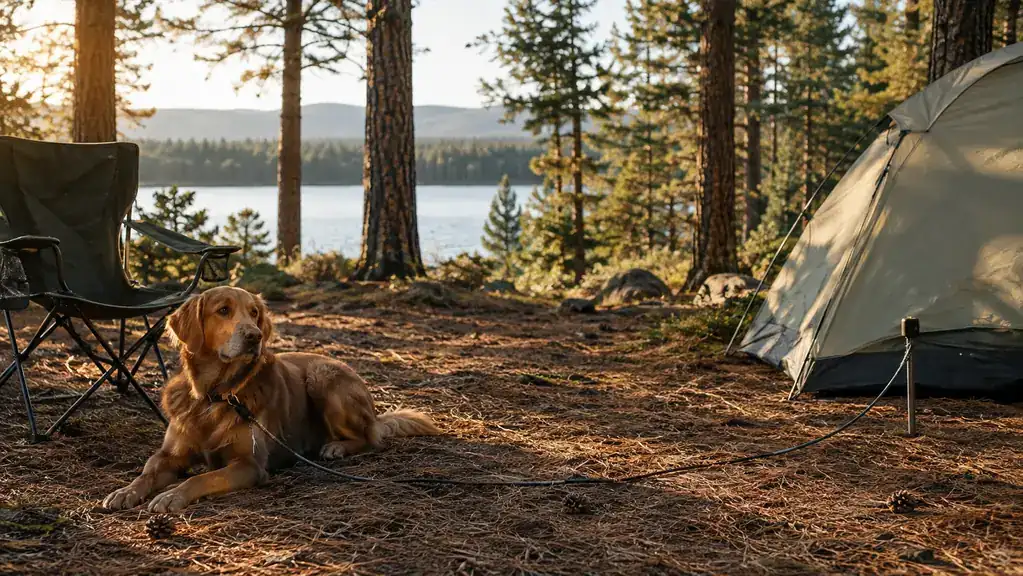
The short answer: a BV tie-out cable with two stakes and a center anchor holds a dog at camp better than any single ground stake I have tried. I say that after three seasons of camping with Tucker, my 55-pound hound mix, at state parks and national forest campgrounds from South Carolina up into the Blue Ridge. I have watched a plain corkscrew stake walk out of the dirt in under a minute. I have also watched the same stake hold firm all night when I used it the way the cable was designed to be used.
This is not a review of one product versus a piece of hardware you already own. It is a review of two ways to solve the same problem: keeping a dog safe and untangled at a campsite where the ground is never as soft or as level as you hope. I tested the BV Dog Tie Out Cable 25 Feet against three different ground stakes over about forty nights of camping. Here is what I learned.
| BV Tie-Out Cable 25 ft | Ground Stake Only | |
|---|---|---|
| Holding power | Two stakes plus a center anchor spread the load; the cable stays put even when Tucker hits the end at a run | One stake takes the full force of a 55-pound dog hitting the end of a line; it pulls loose in soft dirt or after rain |
| Setup time | About 4 minutes once you have done it a few times: two stakes, one center anchor, clip the swivel | Under a minute to screw in, but you will spend the next hour re-setting it every time the dog lunges |
| Tangle resistance | 360-degree rotating clasp and swivel clips let the line spin instead of twisting; Tucker rarely wraps himself | A single stake gives the dog one circle to work with; the line twists, the dog wraps, you untangle |
| Weight in the pack | The full kit is a little over a pound and rides flat against the side of a pack | A steel stake weighs about the same but only does one job |
| Cost | One-time purchase, and the cable outlasted three separate stakes | Cheaper up front, but I replaced three of them in one season |
| Best for | Campers who want to set the dog up once and not think about it again | A quick tie-out on hard, dry ground for a dog that does not pull |
Where the BV Tie-Out Cable Wins
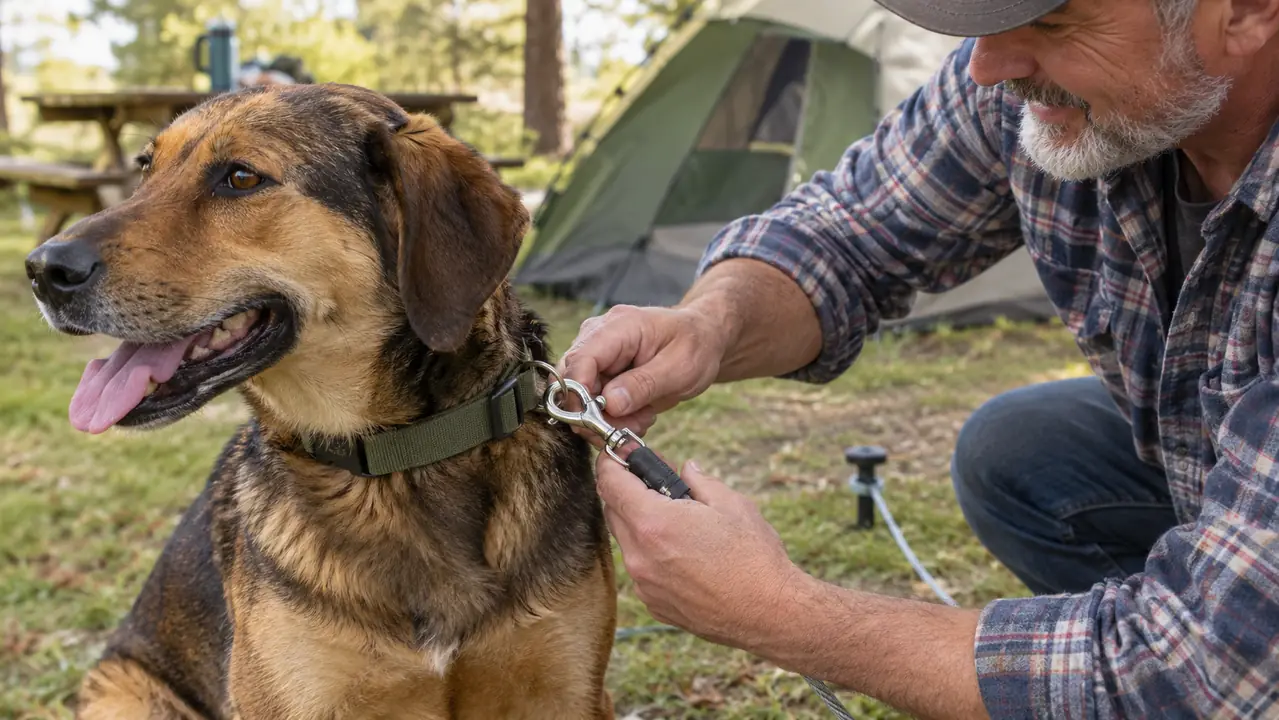
The BV cable wins on the only thing that matters at a campsite: it keeps the dog where you put him. The kit comes with two 11-inch steel stakes and a 25-foot cable with a 360-degree rotating clasp on one end and quick-release swivel clips on the other. The trick is to stake both ends of the cable into the ground and clip the dog to the sliding ring in the middle. That gives Tucker a straight line to run instead of a single circle, and it cuts the pull on any one stake by more than half. When he hits the end of the line at full speed, the two stakes share the load and the center ring just slides along the cable.
I tested it on a Friday night in April at Table Rock State Park. The ground had been soaked by two days of rain, and the campsite was mostly pine duff over clay. I hammered the two stakes in at about a 45-degree angle, clipped the swivels, and let Tucker run. He hit the end of the line twice, hard, the way he does when he sees a squirrel. Both stakes stayed put. The same ground had pulled out a corkscrew stake in about forty seconds the weekend before.
The swivel hardware matters more than it sounds like it should. A single stake setup twists the line every time the dog circles, and a twisted line shortens the radius and makes the dog fight the tangle. The BV cable's rotating clasp spins with the dog, so the line stays flat and the full 25 feet stays usable. I have watched Tucker run the full length of the cable, hit the end, spin, and run back the other way without once wrapping the line around a tree or a table leg.
Range is the other big difference. A stake with a six-foot lead keeps a dog in a circle twelve feet across, which is barely enough for a bowl and a place to lie down. Twenty-five feet of cable gives a circle fifty feet across, enough for shade, water, a bed and a good view of whatever the campground squirrels are doing. A dog with room to move settles down. A dog pinned in a small circle tends to bark, whine and pull, and that is no fun for you or the folks at the next site. Then there is the overnight question. With a single stake and a short lead, Tucker used to spend the night doing slow circles until the lead wrapped the stake and he was pinned with two feet of slack. With the BV cable and its swivel at the anchor, he can turn, stand, lie back down and turn again, and the line never shortens. I used to wake up to a whining dog at three in the morning on the short lead, and I do not anymore.
Set the dog up once and stop re-staking the campsite
The BV Dog Tie Out Cable 25 Feet is the setup I reach for every trip now. Two stakes, a center anchor, and a swivel that actually swivels.
Amazon Check Today's Price on Amazon →Setup time is closer than you might expect. The stake alone takes about a minute to twist into decent ground. The BV cable adds maybe another minute: loop it over the stake, walk out the length, clear anything it could catch on, and clip the dog in. Breaking camp is the same in reverse, plus coiling the cable by hand so it does not kink in the bucket. Two extra minutes on each end of a weekend is a fair trade for a dog who stays put, does not wrap himself up at night and has room to be comfortable.
Where a Ground Stake Wins
Let me be fair about what a ground stake is: a corkscrew or spike that goes in the dirt, usually with a short lead or a ring for your own leash. Many people already own one, or carry one for their tent. It costs little, weighs almost nothing, and works on any patch of ground that will take it.
I am not going to tell you the ground stake is useless, because it is not. A single stake is the right tool when you need to tie the dog out for ten minutes while you cook dinner, when the ground is hard and dry, and when the dog is not a puller. It is also the right tool when you are camping somewhere you cannot hammer a stake, like a rocky ledge or a developed site with a concrete pad. I carry a stake in the truck even now, because there are campsites where the BV cable's stakes will not go in and a stake wedged into a crack in the rock is the only option.
The ground stake also wins on simplicity. There is no learning curve, no two-stake geometry, no center anchor to explain to a friend who is watching the dog for an hour. You screw it in, clip the leash, and you are done. On a dry, hard-packed site with a calm dog, that is genuinely all you need. I used a stake for the first two trips with Tucker and it was fine, right up until it was not. The night it failed, we were at a national forest campground near Brevard, North Carolina. The soil looked dry on top but was soft underneath from a storm three days earlier. Tucker saw a deer at the edge of the site, hit the end of the line, and the stake came out of the ground like a cork. He was gone for twenty minutes. I found him at the next campsite over, eating someone's bacon.
There is also a case for the stake on short stops. At a picnic area, a trailhead lunch or a quick break on a long drive, I am not going to unpack twenty-five feet of cable for twenty minutes. A stake and a regular leash does that job fine, as long as I am sitting right there. Where the stake falls down is time. Over a full weekend, the short range and the wrapping problem wear on both of us.
The stake failed once. The BV cable has not failed in three seasons.
Forty nights of camping, two dogs worth of pulling, and the BV tie-out cable has never let Tucker get loose. That is the whole review.
Amazon Check Today's Price on Amazon →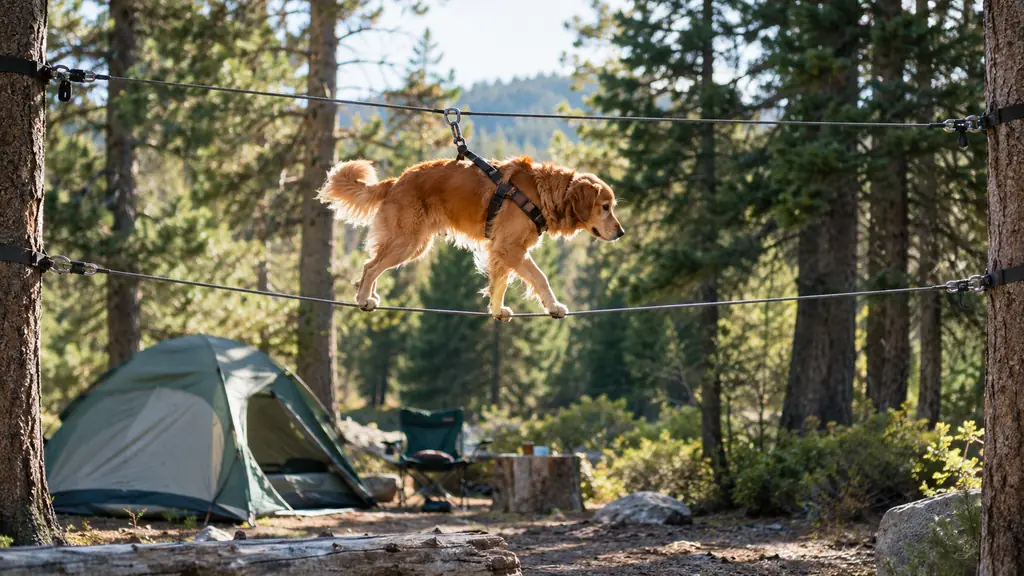
Who Should Buy Which
Here is the simple way I think about it. If the dog will be on the line for more than an hour at a time, you want a cable. If it is a short stop and you are sitting right next to the dog, a stake and a leash is enough. Most camping trips have both kinds of moments, which is why I carry both and use the cable for the long stretches.
Buy the BV tie-out cable if you camp more than a few times a year, if your dog is over 30 pounds, if your dog has ever pulled a stake out of the ground, or if you are tired of untangling a twisted line every time you sit down. It costs a little more than a stake and it takes four extra minutes to set up, but it turns the dog problem into a non-problem for the whole trip. I set it up once on Friday afternoon and do not touch it again until Sunday morning.
That is especially true for dogs like Tucker, the kind who follow their nose first and think second. A stake alone gives that kind of dog a short tether and a lot of frustration. A cable gives him a yard, and a dog with a yard has less reason to test the anchor.
Buy a ground stake if you only tie the dog out for short stretches, if your campsites are always dry and hard-packed, or if your dog is small enough that a firm tug does not move the stake. And buy one anyway as a backup. It weighs almost nothing, it lives in the door pocket of my truck, and it has saved a trip more than once when the ground was too rocky for the BV stakes. The two tools are not really competitors. The cable is the primary system. The stake is the emergency system. I carry both, and I use the cable every single time the ground will take a stake.
It is also worth saying that the two work together. The cable needs an anchor, and on soft ground the best anchor is a good corkscrew stake. So the real question is not stake or cable. It is whether you clip a short leash to that stake or a twenty-five-foot cable with proper swivels. For anything longer than a lunch stop, I clip the cable.
One more thing I learned the hard way: no tie-out replaces supervision. The BV cable held Tucker through three seasons, through rain, through deer, through a bear that wandered through the site at dusk. But I still keep an eye on him, because the point of the cable is not to let the dog run wild. It is to let him move around the campsite safely while I cook, eat, and sleep. If you want that, the BV cable is the one I would buy again. If you want a ten-minute solution for a calm dog on hard ground, the stake will do. Just know which one you are buying before you are chasing a dog through someone else's campsite at 7 a.m.
And whichever you pick, set it up with care. Keep the circle away from the fire ring, the road, other campsites and anything the line can wrap around. Clip to a well-fitted harness or flat collar, never a choke or prong collar. Check the anchor every morning and every evening, because rain and a pulling dog can work any stake loose over a weekend. And bring the dog into the tent or truck when you leave camp, even for a short walk to the bathhouse.