
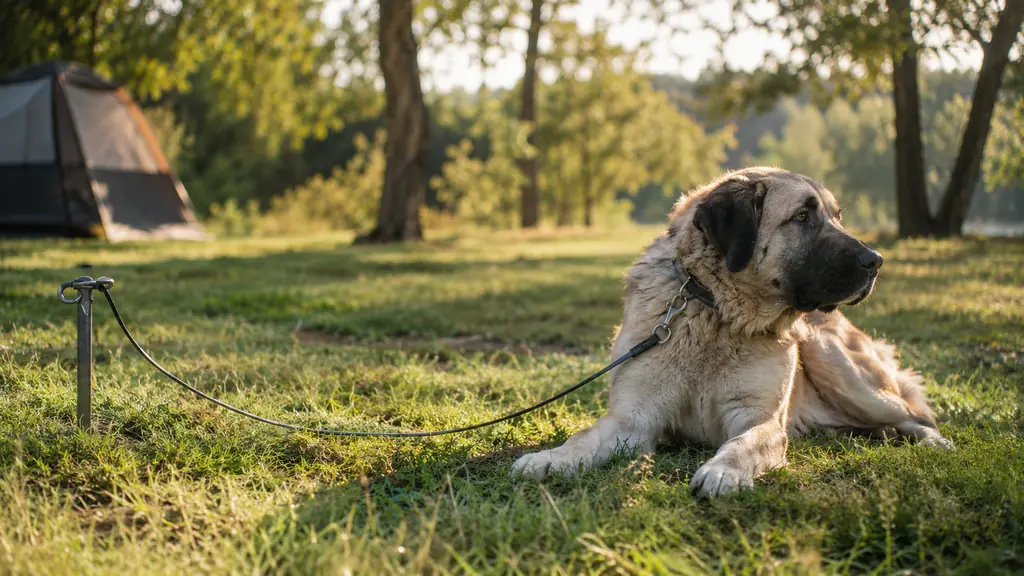
I'll be honest with you. I almost didn't buy the BV Tie-Out Cable. I had already gone through two cheap tie-outs that twisted into knots by the second morning, and I was tired of untangling steel cable with cold fingers before coffee. But Tucker, my six-year-old hound mix, will follow his nose off any campsite if he gets half a chance, so a tie-out is not optional for us. I read the reviews, I checked the price, and I ordered one. Six months and a lot of campgrounds later, here is the honest version of what I found.
The short version: the BV Tie-Out Cable is a solid, well-made runner that does what it says, and it has held up to a 55-pound dog who pulls, circles, and occasionally forgets he is attached to anything. But there are a few things the product page does not tell you, and a couple of them matter more than the rest.
The Quick Verdict
A tangle-free, rust-resistant tie-out that earns its spot in the truck bed. Not perfect, but the best 25-foot runner I have used with a dog that likes to wander.
Amazon Check Today's Price →Stop untangling knots before your coffee
The BV Tie-Out Cable's swivel clips and rotating clasp are the reason I stopped fighting with twisted cable every morning. If you camp with a dog that circles, this is the fix.
Amazon Check Today's Price on Amazon →How I've Used It
I have used this cable on maybe twenty trips since last spring. State parks in the Blue Ridge, national forest campgrounds, a few nights in the truck bed with the topper down. Tucker has slept on it, eaten dinner on it, chased squirrels to the end of it, and once wrapped it around a picnic table leg so thoroughly that I thought about cutting it loose. The cable survived. The table survived. I did not.
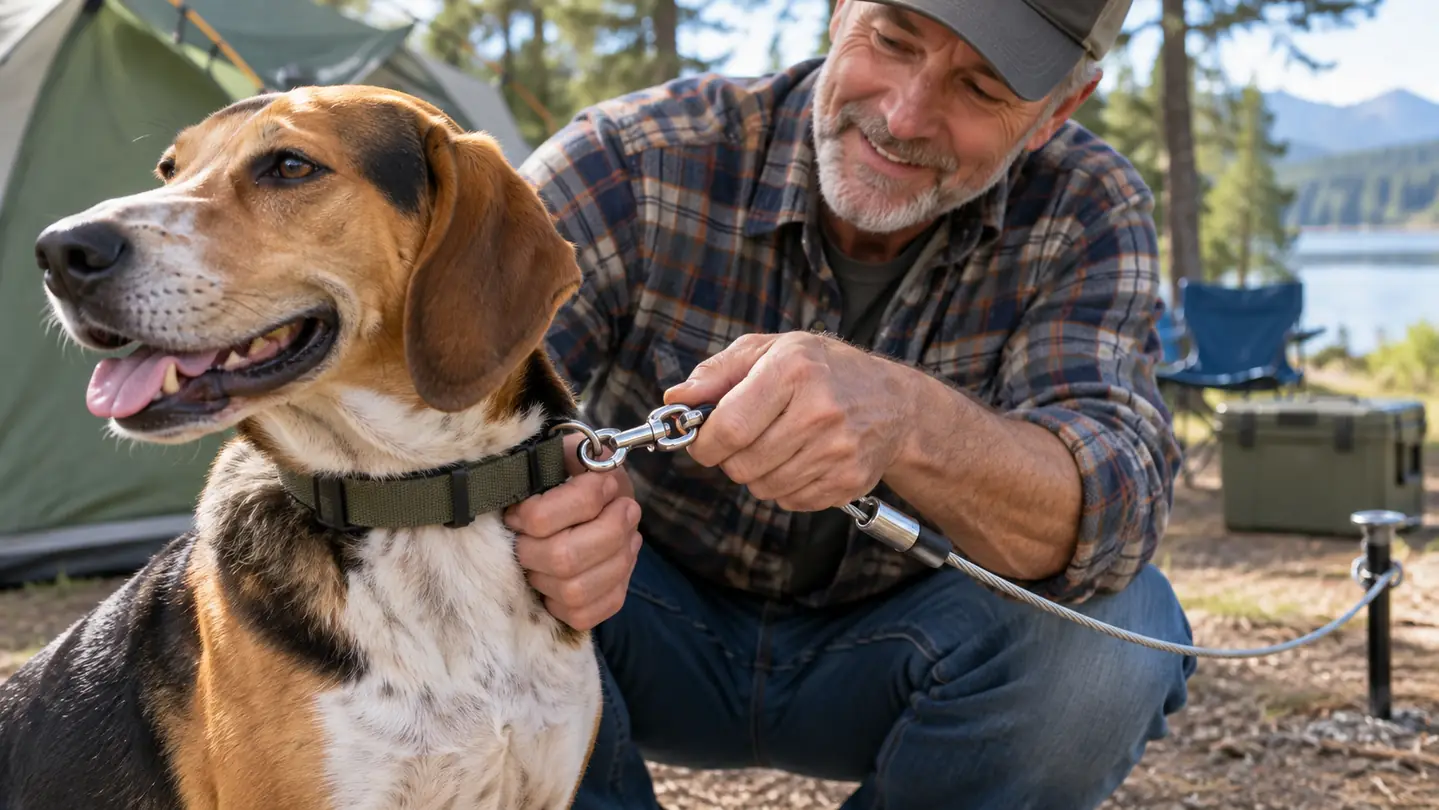
The setup is simple. The cable comes coiled, with a stake at one end and a swivel clip at the other. You drive the stake into the ground, clip the swivel to Tucker's collar, and he has 25 feet of run in a circle around the stake. The 360-degree rotating clasp at the collar end is the part that makes it work. When Tucker changes direction, the clasp turns with him instead of twisting the cable into a spiral.
I have also used it at home in the yard, which I did not expect to do. It is handy for keeping a dog out of the garden while you are working, and the reflective stitching on the cable shows up well in low light. If you have ever nearly tripped over a dark tie-out at dusk, you will appreciate that detail more than you think.
The first real test came in late April at a national forest campground about an hour from the house. The site was gravel with a hard-packed clay base, and the forecast called for rain both nights. I drove the stake in straight, clipped Tucker to the swivel, and let him work the perimeter. He circled, doubled back, and ran the line out to the full 25 feet more times than I counted. The cable stayed flat and straight every time. By Sunday morning the stake had not moved a quarter of an inch, even after a night of steady rain.
That trip taught me where the stake belongs. I set it about 12 feet from the picnic table and 15 feet from the fire ring, which gives Tucker the run of the camp without putting the cable across the path where people walk. The 25-foot length sounds small on paper, but in practice it covers a lot of ground. He can reach his bed, his water bowl, and a good patch of grass to lie on, and I can sit at the table without him winding around my chair. I have used shorter cables, and they turn a campsite into a tripping hazard. This one, placed with a little thought, stays out of the way.
The only time I came close to trouble was a windy afternoon when a gust caught Tucker mid-leap. He landed at an angle, the swivel turned, and the cable folded into a single loop instead of a knot. I straightened it in about twenty seconds. On the old cable, that same move would have taken me ten minutes with a knife.
What Nobody Tells You About the Swivels
The product page talks about the quick-release swivel clips and the rotating clasp, and all of that is true. What it does not tell you is that the swivels are the reason this cable works, and they are also the part you need to check before every trip. Dirt, pine needles, and the general grime of a campsite can work their way into the rotating parts. I have had the collar-end clasp get stiff after a rainy weekend, and a stiff swivel is a twisted cable waiting to happen.
The fix takes ten seconds. A little water, a little wiping, and the swivel turns freely again. I keep a small cloth in the truck for exactly this. It is not a flaw in the cable, it is just the nature of any mechanical part that lives outside. But nobody tells you that in the reviews, so I am telling you now.
The stiff-swivel moment I keep mentioning happened on the second morning of a rainy trip in May. Tucker had spent the night under the truck topper, but the cable had lain in wet grass until noon. When I picked it up, the collar-end clasp turned with a gritty feel, and within an hour the cable had a twist in it. I rinsed the clasp in the creek, dried it with my shirt, and it was smooth again. The whole fix took maybe two minutes.
Since then I do a quick check every morning: spin the collar-end clasp, spin the stake-end clip, and run my thumb over the swivel. If either one hesitates, I give it a blast of water and a drop of light oil. I carry a small bottle of oil in the truck's glovebox, next to the rag. That routine has kept the cable working through the rest of the season.
Here is the part I did not expect: the quick-release clips are actually quick. The ones on my old cable needed two hands and a lot of swearing. These snap open with one thumb, even when Tucker is pulling. That matters at the end of a long day, when you are trying to unclip a tired dog in the dark.
One more thing about the swivels. They are quiet. My old hardware clinked every time the dog moved, which meant I woke up at every shift in the night. This cable makes almost no sound, so Tucker can turn around in his sleep without me hearing it and worrying that he has gotten loose.
The swivels are the reason this cable works, and they are also the part you need to check before every trip.
The Stake Is Good, With One Caveat
The included stake is a spiral-style ground anchor, and it has held firm in every campground I have used it in. Grass, dirt, even the packed gravel of a well-used site. Tucker has hit the end of the cable at a full run more than once, and the stake has not pulled out. That is the good news.
The caveat is that the stake needs to go in straight. If you drive it in at an angle, it can work loose over a long afternoon. I learned this the hard way on a site with hard, rooty ground. I got the stake in at a slant, Tucker leaned on the cable, and by evening the stake was leaning badly enough that I moved the whole setup. Drive it straight and it holds. That is all there is to it.
The angle problem showed up on a site with a lot of roots. I picked a spot that looked clear, but two inches down the stake hit a root and I forced it. The stake went in maybe twenty degrees off vertical. Tucker tested it within an hour, and by late afternoon the stake had loosened enough that I could wobble it with my hand. I pulled it, moved three feet to the left, and drove it straight into softer ground. It held for the rest of the weekend.
That experience taught me to read the ground before I commit. If the first few turns of the stake meet real resistance, I pick another spot. It takes less than a minute to move, and it saves a whole afternoon of watching the stake lean. I also make sure the loop at the top of the stake is facing the direction Tucker is most likely to pull, so the cable runs out clean instead of rubbing against the stake.
One more note: the stake is not foolproof in soft sand. On a river bar, the spiral pulled out twice before I gave up and tied the cable around the base of a tree with a length of rope. The stake is excellent for campground dirt, but if you camp on sand, bring a different anchoring plan.
I also learned to carry a small mallet. The stake has a flat top you can push with your foot, but on hard ground a few taps from a mallet seat it deeper. I keep a rubber mallet behind the seat of the truck, and it has earned its space.
How It Holds Up Over Time
After six months of regular use, the BV cable looks almost new. The coating has not cracked, the clips still snap shut cleanly, and the reflective stitching has not frayed. I have left it out in the rain, dragged it through mud, and once packed it away wet by accident. No rust. That is the part that surprised me most, because I have had other cables rust within a season.
The one thing I watch is the clip at the collar end. It is a solid piece of hardware, but it is the part that gets the most abuse. Tucker pulls against it, it drags on the ground, it gets stepped on. I check it for wear before every trip, and so far it has not needed replacing. If it ever does, it is a standard clip that any hardware store will have.
The worst treatment it has gotten was a November trip where I packed it away wet and then forgot about it for three weeks. When I finally pulled it out of the bin, the cable had dried with a few water spots and a little dust on the coating. I wiped it down, and it looked the same as the day I bought it. No rust, no stiffness in the clips.
The reflective stitching is the one cosmetic thing I would watch. After a season of dragging over gravel, the stitching is still intact but it has picked up some dull spots. It is still visible at dusk, just not as bright as the first month. That has not affected how the cable works, but if you rely on the reflection to keep people from tripping, know that it fades a little.
I have also checked the cable for kinks. Steel cable has a memory, and a hard kink can turn into a weak point. Mine has none, because the swivels do their job. On my old cable, the twists and kinks were permanent after one season. This one still uncoils straight.
The clips are the part I inspect most. The spring in the collar-end clip still snaps shut with a clean click, and the teeth that hold the collar ring are not worn down. I figure a standard replacement clip costs less than a new cable, so even if it wears out in another year, I will replace the clip and keep the cable. It is not a lifetime product, and I would not pretend it is. But it has already earned its keep.
Who This Is For
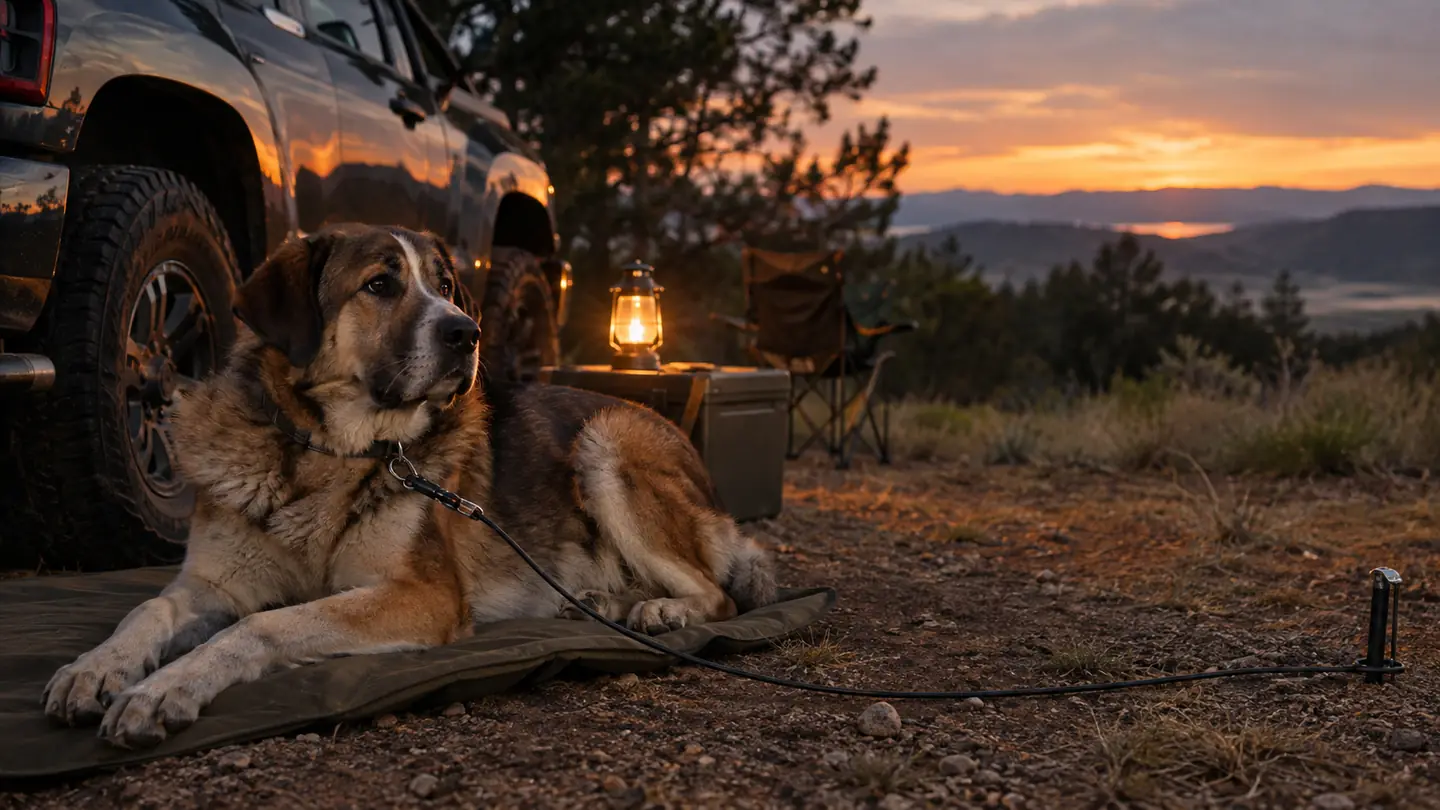
This cable is for anyone who camps with a dog that cannot be trusted off-leash. If your dog stays by the fire and never wanders, you do not need a tie-out at all. But if your dog is like Tucker, a hound who will follow a scent into the next county, the BV Tie-Out Cable is a simple, reliable way to keep them safe at the campsite. It is also a good choice for the yard, for a dog that needs to be outside while you work, or for a dog that likes to circle and would tangle a standard cable in minutes.
Who Should Skip It
Skip it if your dog is a serious chewer. The cable itself is steel, but the clips and the swivel are metal parts that a determined chewer could damage. Skip it if you need a permanent yard setup, because a spiral stake is meant for temporary use and will not hold in soft, sandy soil the way a concrete-anchored post will. And skip it if your dog is over the 90-pound rating. The cable is rated for dogs up to 90 pounds, and I would not push that limit. A bigger dog hitting the end of the line at full speed is a lot of force.
What I Liked
- Swivel clips and rotating clasp genuinely prevent tangles
- Reflective stitching makes the cable visible at dusk
- Rust-free coating has held up through rain and mud
- Stake holds firm in normal campground ground
- 25 feet gives a dog real room to move
Where It Falls Short
- Swivels need occasional cleaning to stay smooth
- Stake must be driven straight or it can work loose
- Not for dogs over 90 pounds
- No carrying bag included
Alternatives I Considered
Before I settled on the BV, I tried a basic cable with a clip at each end and no swivels. It twisted into a mess by the second day. I also looked at a heavier chain-style runner, but it was overkill for a 55-pound dog and a lot more weight to carry. The BV sits in the middle: lighter than a chain, smarter than a plain cable, and priced reasonably for what it does.
I have not tried every tie-out on the market, so I cannot tell you this is the best one ever made. I can tell you it is the best one I have used, and I have used enough of them to know what I am looking for. If you want a tie-out that does not tangle, does not rust, and does not cost a fortune, the BV is worth a look.
Give your dog 25 feet of freedom, without the tangles
The BV Tie-Out Cable has been in my truck for six months and it has not let me down. If you camp with a dog that wanders, this is the one I would buy again.
Amazon Check Today's Price on Amazon →